
Last Updated: November 12, 2026
Quick Summary
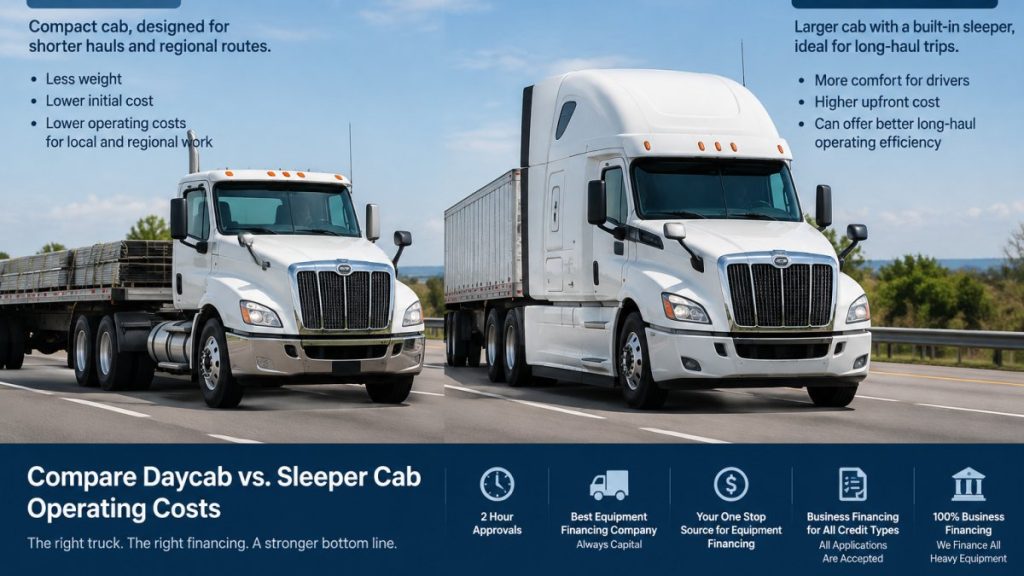
Daycab vs sleeper costs split first at purchase, where day cabs typically run $15,000 to $40,000 less than comparable sleepers. Day cabs also burn less fuel and carry fewer systems to maintain, while sleepers protect driver rest and resale in long-haul freight corridors.
- Day cabs make up 69% of Class 8 purchases while sleepers account for 31%.
- Day cab trucks generally range from $70,000 to $150,000; sleepers run $100,000 to $200,000 or more.
- Buying a day cab for over-the-road lanes usually backfires through motel bills and driver turnover.
- Resale value tracks regional freight demand more than cab type or original sticker price.
Table of Contents
- The Daycab vs Sleeper Operational Split
- Upfront Purchase Price: Where the Gap Starts
- Fuel Economy and Tare Weight Behind the Wheel
- Maintenance Intervals, Idle Time and Driver Fatigue
- Resale Value and Regional Market Demand
- Commercial Truck Financing for Either Cab Configuration
- Fleet Expansion Capital When You Add Both Types
- Upgrade Your Daycab or Sleeper with Always Capital
- Frequently Asked Questions
The Daycab vs Sleeper Operational Split
The daycab vs sleeper decision starts with a simple fact: the industry-average cost to operate a truck hit $2.336 per mile in 2025, a 3.4% jump from $2.26 the year before, according to the American Transportation Research Institute’s operational cost analysis. That number is a blended average, and it hides one of the biggest structural choices a carrier makes. Always Capital works with fleets of every size on this exact decision, and the pattern is consistent: cab configuration drives purchase price, fuel economy, maintenance exposure, and resale in ways that compound over years.
Day cabs make up 69% of Class 8 purchases, sleepers 31%, per FleetOwner’s 2026 trucking statistics. That split is not an accident. It reflects where freight actually moves and how far.
Daycab vs sleeper is a question of matching the truck to the route, not picking the “better” cab. Get that match wrong and the cost gap widens every month.
Upfront Purchase Price: Where the Gap Starts
Day cabs typically cost $15,000 to $40,000 less than comparable sleeper cabs at purchase, per Apple Truck and Trailer’s acquisition cost comparison. That gap is the single largest line item separating the two configurations, and it sets the tone for everything downstream.
Day cab trucks generally range from $70,000 to $150,000. Sleeper trucks run $100,000 to $200,000 or more, per Alogix market pricing data. The spread widens with sleeper size, bunk amenities, and powertrain spec.
For a buyer weighing a sleeper, how to finance a Freightliner Cascadia sleeper walks through the funding mechanics specific to that model. The upfront capital expenditure difference is real, but it is only the opening move in the total cost of ownership calculation.
Fuel Economy and Tare Weight Behind the Wheel
Sleeper cabs carry more tare weight and more aerodynamic drag than day cabs, and both show up at the fuel pump. A lighter day cab pulling regional freight burns less fuel per mile on comparable routes, which matters when operating expenses are already climbing toward a projected $2.51 per mile in 2026 models, per TruckWriters’ 2026 cost outlook.
Tare weight also eats into payload capacity. Every pound of cab and bunk is a pound of freight the truck cannot legally carry. For short-haul and regional haul work, where loads are frequent and margins thin, that trade-off is easy to see on the scale ticket.
Long-haul trucking flips the math. A day cab on an over-the-road lane means paying for motels, meals, and lost hours, which often costs more than the fuel a sleeper burns. Aerodynamics and cab configuration are a package deal with the route, not a standalone spec sheet win.
Maintenance Intervals, Idle Time and Driver Fatigue
Sleeper cabs tend to rack up idle time. Bunk climate control, auxiliary power units, and long dwell periods at shippers can add wear that day cabs mostly avoid. A day cab that shuts down at the yard each night avoids the sustained idle hours that age a sleeper’s APU, bunk HVAC, and aftertreatment system.
The maintenance math is not just about engine hours. Sleepers carry more systems, bunk climate control, auxiliary power, extra electrical load, and a larger cab envelope, so there are simply more components to service. Day cabs run a leaner spec, which means fewer failure points and lower parts exposure over the life of the truck. A day cab’s leaner spec generally makes its maintenance profile easier to predict, which helps when building a per-mile operating budget.
Driver fatigue is the other half. A sleeper lets a driver rest legally and comfortably between shifts, which supports driver retention in a market where good drivers are hard to keep. A day cab sends the driver home or to a motel, and for long-haul lanes that arrangement wears people down. The fatigue angle is also a compliance angle: hours-of-service rules and electronic logging devices reward a truck that lets the driver take a proper rest break in the cab. A sleeper keeps the driver legal and rested without a motel detour; a day cab on a long lane forces the driver to find rest elsewhere, and the lost hours show up in the schedule.
Insurance premiums can differ by configuration, since long-haul lanes carry more miles, more night driving, and more time away from home base.
Watch out: buying a day cab for over-the-road lanes to save on the sticker price usually backfires. The savings get eaten by motel bills, reduced driver retention, and hours-of-service friction within the first year.
When the route fit points to a sleeper, Always Capital offers tractor financing with 30, 60, or 90-day payment deferrals so the truck can earn before the first payment comes due. Always Capital also offers heavy equipment loans and equipment leases, with all credit types accepted and soft pulls only.
Resale Value and Regional Market Demand
Resale value tracks regional market demand more than any spec sheet. Day cabs often hold value in regions with dense short-haul freight and port drayage, where buyers want a tractor that turns quickly. Sleepers often hold value where long-haul lanes dominate. The same truck can be a strong asset in one freight corridor and a slow mover in another, which is why the buyer pool matters as much as the book value.
The depreciation rate on either configuration depends on hours, mileage, and maintenance history, not cab type alone. A well-maintained truck can outsell a neglected one, regardless of cab type. Buyers in the secondary market price the working asset, not the label. That is why service records, idle hours, and a clean DOT inspection history move the number more than the bunk ever will.
Equipment versatility matters here too. A day cab can be redeployed across regional lanes, local delivery, drayage, and vocational work, which widens the pool of second owners. A sleeper is purpose-built for distance, which narrows the buyer pool at resale but deepens it among long-haul operators. For a full case on the day cab side, daycab benefits for regional hauling lays out the operational logic.
Some owner-operators buy a used day cab for a regional lane and sell into the same regional market later, which can keep the resale impact smaller. The opposite pattern, buying a sleeper for a short-haul lane, forces the truck into a market that does not want it, and the discount shows up at trade-in.
Watch out: assuming a sleeper always resells higher because it cost more new. Resale depends on market conditions and the truck’s specification and history.
When it is time to upgrade either configuration, Always Capital offers daycab financing with soft pulls only, approvals in as little as two to four hours, and terms from 24 to 84 months. Always Capital also finances older, high-mileage trucks with no age or mileage restrictions. For a reader exploring options, used day cabs and dump trucks for sale are worth a look.
Commercial Truck Financing for Either Cab Configuration
Cab type should not decide whether a deal gets funded. Always Capital offers commercial truck financing with approvals in as little as two to four hours and up to 100% financing. Soft credit pulls only, so pre-qualifying does not touch a business or personal score.
The application-only tier funds up to $500,000 without extensive financial statements. Terms stretch from 24 to 84 months, and payment deferrals of 30, 60, or 90 days let a newly acquired truck earn revenue before the first payment comes due.
| Financing Feature | What It Means for a Cab Purchase |
|---|---|
| Approval speed | Decisions in 2 to 4 hours |
| Financing amount | Up to 100%, limits to $5 million |
| Application-only tier | Up to $500,000, no financials |
| Credit pull | Soft pull only, no score impact |
| Terms | 24 to 84 months |
| Deferrals | 30, 60, or 90 days |
For a reader ready to move on either configuration, fastest commercial truck financing with 2-hour approvals shows the path. Always Capital also finances older, high-mileage trucks with no age or mileage restrictions, and supports auction and private-party purchases.
Fleet Expansion Capital When You Add Both Types
Plenty of fleets do not choose one cab type. They run day cabs on regional lanes and sleepers on long-haul, matching equipment versatility to freight demand. Funding that mix takes fleet expansion capital that can bundle multiple units into one structure.
Always Capital offers multi-unit fleet expansion financing and single-unit additions for owner-operators. High lending limits scale to $5 million, and all credit types are accepted.
Fleet financing for trucks and equipment covers how to structure a mixed purchase. The practical point: fund the fleet as a system, not one truck at a time, so cash flow stays predictable across the whole operation.
Upgrade Your Daycab or Sleeper with Always Capital
The cost split between day cab and sleeper comes down to route fit. Buy the cab that matches the freight, and the operating numbers stay honest. Buy against the freight, and the gap widens every month.
Always Capital is a one-stop source for equipment and commercial truck financing, with 2 to 4 hour approvals, 100% financing options, soft pulls only, and all credit types accepted. Transparent loan terms are part of how the business works with its customers.
Get pre-approved for heavy equipment financing with Always Capital and put the right cab to work.
The right cab configuration only pays off when the funding behind it fits the business. Always Capital offers same-day approvals in two to four hours, 100% financing up to $5 million, and application-only approvals up to $500,000 with no financials required. Get started with Always Capital and upgrade your fleet without draining working capital.
Frequently Asked Questions
Are day cabs cheaper than sleepers?
Yes. Day cabs generally cost less than comparable sleeper cabs at purchase, because the sleeper adds a bunk, a longer frame and extra amenities. For regional haul work that returns to base nightly, that savings goes straight into working capital, and Always Capital can provide tractor financing to help manage your fleet assets.
Are day cabs more cost-effective for local routes?
For short-haul and regional haul routes, day cabs can be a practical choice for operating expenses, since they avoid the extra tare weight of a bunk. The catch is driver retention: if your routes stretch past a legal driving window, a sleeper becomes the practical choice. Match the cab configuration to your actual freight logistics before committing, and let Always Capital structure commercial truck financing around the routes you run.
How does vehicle weight impact operating costs for daycabs versus sleepers?
A sleeper cab adds tare weight for the bunk, longer frame and cab amenities, which can trim payload capacity on the same tractor. Less payload per trip means more trips or fewer revenue tons for the same fuel economy. Day cabs carry less weight, which can matter for payload on regional runs. Total cost of ownership reflects many factors, including fuel and maintenance.
How can financing help manage the transition between daycab and sleeper fleets?
Financing lets you add the cab type your routes demand without draining cash reserves. Always Capital offers up to 100% financing, approvals in as little as two to four hours, and soft credit pulls. Payment deferrals of 30, 60 or 90 days are available to protect cash flow. Fleet expansion capital can bundle multiple units, and Always Capital finances trucks regardless of age or mileage.
