
Table of Contents
- Heavy Equipment Financing Requirements: What Lenders Actually Check
- How to Prepare Your Business Profile for Low Interest Heavy Machinery Loans
- Financing for Used Heavy Machinery: What Changes When Equipment Is Older
- The Construction Equipment Loan Application Process: Step by Step
- Equipment Appraisal, Valuation, and the Role of Collateral
- Navigating Private Party Sales and Dealership Purchases
- Frequently Asked Questions
Last Updated: September 13, 2026
Heavy Equipment Financing Requirements: What Lenders Actually Check
Qualifying for heavy machinery loans comes down to three things lenders weigh first: credit history, business tenure, and revenue. This guide from Always Capital breaks down what underwriters review, so a file can be strengthened before it reaches a desk.
A common mistake is assuming the equipment itself carries the application. It does not. Lenders read the business first and the machine second. According to U.S. Small Business Administration guidance on [business credit(/blog/improve-business-credit-score-loans/) | sba.gov], a business credit profile is built from payment history with suppliers, lenders, and vendors, separate from the owner’s personal file. That distinction matters more than most applicants realize.
Below is what gets checked, in the order underwriters usually check it.
Credit Score, Time in Business, and Annual Revenue Thresholds
Credit score is the first filter, but not a pass-or-fail gate. Lenders review the business profile and the owner’s personal score together, and strong revenue can offset a thin file.
Time in business signals stability. A company with years of steady contracts reads differently than one that opened last quarter, though many lenders work with newer businesses when the equipment is strong collateral.
Annual revenue tells the lender whether the business can carry a repayment schedule. Underwriters compare revenue against existing obligations, not a fixed number.
What Lenders Check | Why It Matters | How to Strengthen It |
|---|---|---|
Credit score | Signals repayment history | Pay vendors early, separate business credit |
Time in business | Signals stability | Document contracts and repeat clients |
Annual revenue | Signals repayment capacity | Show consistent deposits and signed work |
Collateral | Backs the loan | Choose equipment with strong resale demand |
Collateral, Loan-to-Value Ratio, and Personal Guarantees
Collateral is the equipment being financed and the lender’s fallback if payments stop. The loan-to-value ratio compares the amount financed against the machine’s appraised value; a lower ratio means less risk.
A personal guarantee is common on equipment deals, especially for younger businesses, the owner stands behind the loan personally. That is standard practice, not a red flag.
Asset-backed loans move faster than unsecured options because the machine does the heavy lifting in underwriting. For borrowers weighing secured vs. unsecured equipment loans, secured deals usually open the door to more flexible repayment terms.
How to Prepare Your Business Profile for Low Interest Heavy Machinery Loans
Preparation, not persuasion, moves an application from eligible to favorable. Two areas do most of the work: the business credit profile and the cash flow story.
Strengthen Your Business Credit Profile Before You Apply
Start with the basics: confirm the business is registered correctly, entity information matches across documents, and vendor accounts are current. Errors on a business credit file are common and slow applications down.
Then separate finances. A dedicated business bank account with consistent activity gives underwriters something clean to read; mixing personal and business spending reads as risk.
- Verify business registration and entity details match across all documents
- Pull the business credit report and dispute any errors
- Bring vendor and supplier accounts current
- Keep business banking separate from personal accounts
- Gather two years of business bank statements if available
Improve Cash Flow and Debt Service Coverage Ratio
Debt service coverage ratio compares available cash flow against total debt obligations, showing whether the business can absorb a new payment without strain.
Improving it before applying is straightforward: collect outstanding invoices, delay large discretionary purchases, and avoid stacking new debt. Working capital and liquidity both factor into how comfortable the file looks.
A cash flow analysis built from real deposits and signed contracts beats a verbal summary of upcoming work.
Financing for Used Heavy Machinery: What Changes When Equipment Is Older
Age changes the conversation, but it does not end it. Financing for used heavy machinery hinges on condition, hours, and resale demand rather than model year alone. A well-maintained machine with documented service history holds value a neglected newer unit does not.
What shifts with older equipment:
- Appraisers weigh condition and hours more heavily than age
- Service records become a primary document, not a nice-to-have
- Some lenders shorten repayment terms on older units
- Refinance options may be limited once a machine passes a certain point
Always Capital finances older equipment and trucks with no restrictions on age or mileage, removing a barrier that stops many applications elsewhere. For contractors with a proven excavator financing or dump truck financing need, that flexibility often decides whether a deal closes.
The Construction Equipment Loan Application Process: Step by Step
The construction equipment loan application process moves quickly when the file is complete. Missing documents, not underwriting, cause most delays.
- Identify the equipment. Confirm the make, model, year, hours, and seller.
- Submit the application. Basic business details and equipment information start the review.
- Complete the soft credit pull. A soft pull does not affect credit scores.
- Receive a decision. Always Capital delivers approvals in as little as two to four hours.
- Review the terms. Confirm the schedule, term length, and any deferred payment option.
- Finalize and fund. Sign, and the equipment is released to the business.
Always Capital offers application-only approvals with no financials required on qualifying deals, plus 100% financing options and terms from 24 to 84 months.
Documents You Will Need to Submit
For application-only approvals, the document list is short: basic business information, equipment details, and a signed application. Larger requests may require financial statements, a balance sheet, and business bank statements, having those ready keeps a file moving.
Equipment Appraisal, Valuation, and the Role of Collateral
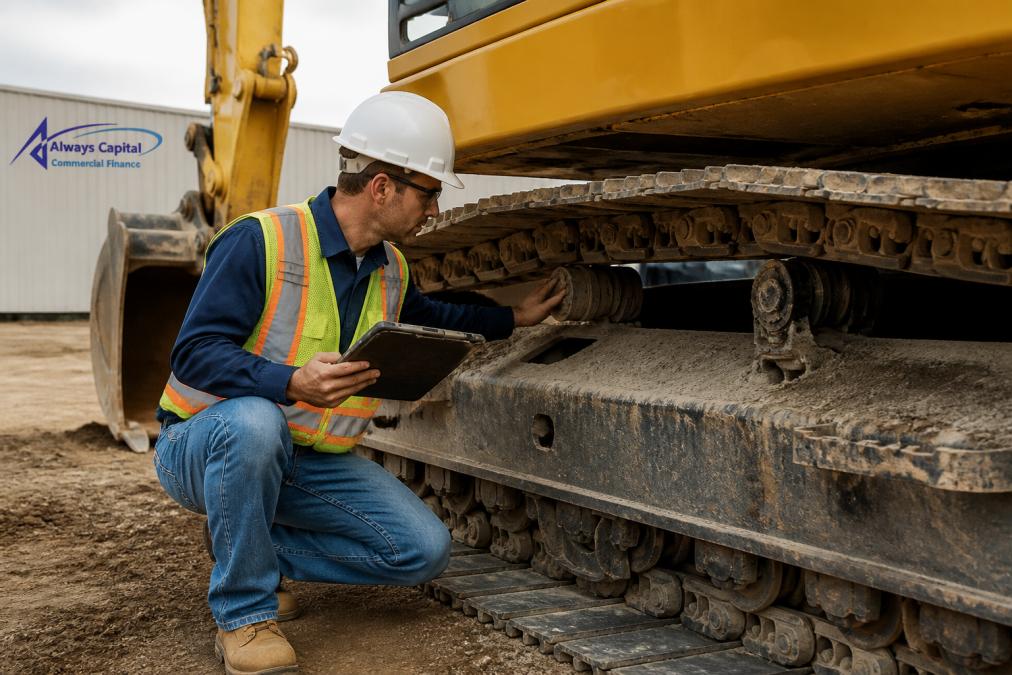
An equipment appraisal establishes what a machine is worth, and that number shapes the entire deal. Appraisers inspect condition, hours, maintenance history, and comparable sales; the result sets the loan-to-value ratio and the lender’s collateral coverage.
How Appraisers Actually Arrive at a Number
Most machinery appraisals lean on three valuation approaches, and the appraiser picks the one that fits the asset:
- Comparable sales approach. The appraiser pulls recent auction and dealer transactions for the same make, model, and year, then adjusts for hours, condition, and attachments. This is the default method for late-model, high-volume machines like skid steers and compact excavators.
- Cost approach. Replacement cost minus depreciation. Common for specialty or low-volume units where comparable sales are thin.
- Income approach. Used when the machine is a revenue producer with a trackable earnings history, less common for construction iron, more common for certain trucking assets.
A machinery appraisal also protects the borrower: an accurate valuation prevents financing more than a machine is worth, keeping the schedule aligned with real asset value.
New vs. Used: Where the Numbers Diverge
New equipment appraisals are straightforward, the invoice and dealer pricing set the baseline, and depreciation starts the moment the machine leaves the lot. Used appraisals are where the real work happens. Appraisers weigh:
- Hours on the meter relative to the machine class (a 6,000-hour excavator reads very differently than a 6,000-hour skid steer)
- Undercarriage, hydraulic, and engine condition, the three areas that drive most repair exposure
- Service records showing scheduled maintenance and major component work
- Attachments and options that carry resale demand (thumb, breaker, quick coupler, GPS grade control)
- Tire or track life remaining, which is often the single largest line item on a used machine
A well-documented, one-owner machine with dealer service history routinely appraises higher than an identical unit with no paper trail, that gap is the appraiser’s read on future repair risk.
How Borrowers Influence the Appraised Value
Appraisal is not a passive event. Borrowers who prepare consistently see stronger numbers:
- Wash and detail the machine before inspection. Presentation signals care, and appraisers notice.
- Assemble a service binder. Dealer invoices, oil sample reports, and repair records all support a higher condition grade.
- Photograph everything. Undercarriage, engine bay, cab, hour meter, and any recent component replacements.
- Disclose known issues. Hidden problems found during inspection damage credibility more than the issue itself.
- Time the appraisal well. A machine coming off a major service or with fresh undercarriage work appraises better than one due for either.
Why This Matters for the Deal
A higher appraised value means stronger collateral, and stronger collateral gives a lender more room to structure favorable terms, including longer repayment terms and more flexible structures on secured vs. unsecured equipment loans. Always Capital finances older equipment and trucks with no restrictions on age or mileage, so a strong appraisal on a high-hour machine can still carry the file.
Navigating Private Party Sales and Dealership Purchases
Private party sales and dealership purchases follow different paths, and knowing which applies saves time. A dealership purchase comes with an invoice, warranty documentation, and a known title chain, which lenders process quickly. Private sales require more legwork, but they are entirely financeable when the paperwork is handled correctly.
Why Dealership Deals Move Faster
A dealer transaction is essentially pre-packaged for underwriting. The dealer supplies:
- A purchase invoice with make, model, year, hours, and serial number
- A clean title or manufacturer’s statement of origin
- Warranty and service documentation
- A known entity the lender can verify and pay directly
Because the lender pays the dealer directly and the dealer handles title transfer, there is little room for the deal to go sideways. That is why dealership purchases typically clear underwriting with fewer conditions.
The Private Sale Playbook
A private sale puts the buyer in the middle of the transaction, and that is where most deals stall. The lender is not paying a known business, it is paying an individual, often someone the lender has never dealt with. To close that gap, the buyer needs to assemble a package before approaching a lender:
- Bill of sale. Signed by both parties, listing make, model, year, serial number, hours, and the agreed purchase amount.
- Title verification. A copy of the front and back of the title, confirming the seller’s name matches the bill of sale.
- Lien search. Confirms the machine is free of existing claims. A title with an open lien cannot be transferred cleanly until that lien is released.
- Independent appraisal. Most lenders require one on private sales because there is no dealer invoice to anchor value. See the appraisal section above for how to prepare.
- Seller identification and contact information. The lender will want to verify the seller is who they claim to be.
- Photos and inspection report. Condition documentation supports the appraisal and speeds review.
How the Money Actually Moves
This is the part most guides skip. On a private sale, the lender does not hand the buyer a check to carry to the seller. The standard structure is:
- The lender funds the deal directly to the seller once all conditions are met
- Title transfer and lien placement happen simultaneously, the lender’s lien is recorded on the new title before or at the same time funds release
- The buyer takes possession only after the title work is confirmed
Some sellers are uncomfortable with this structure because they do not get paid the moment they hand over the keys. Explaining upfront that the lender is a known financing company, funds are wired on a set schedule, and title work is handled by the lender prevents the deal from falling apart at closing.
Common Private Sale Pitfalls
- Open liens on the title. The most common deal-killer. Resolve the lien release before scheduling closing.
- Title in a name that does not match the seller. Estate sales, business sales, and machines held in an LLC all require extra documentation.
- No serial number verification. Lenders will not fund a machine they cannot positively identify.
- Seller unwilling to wait for funding. Set expectations early, funding is not instant, but it is predictable.
- Machine located out of state. Title and lien rules vary, and the lender may need additional time to record the lien correctly.
Which Route Fits the Deal
Dealership purchases are simpler and faster. Private sales often unlock better pricing, rarer machines, or equipment from a retiring owner, and they are worth the extra preparation when the machine is right. Buyers who gather title documents, an appraisal, and a clean bill of sale upfront move through underwriting at nearly the same pace as a dealership deal.
Always Capital finances equipment from both dealers and private sellers, including older machines with no restrictions on age or mileage. For contractors chasing a specific excavator financing or dump truck financing opportunity that only exists on the private market, that flexibility is often what makes the deal close.
Start the title and lien search before you agree on a price. Discovering an open lien after you have shaken hands is the fastest way to lose a machine you already committed to.
Frequently Asked Questions
What credit score is needed to qualify for low interest heavy machinery loans?
Most lenders look for a credit score of 650 or higher to offer their best terms on heavy machinery loans. Scores between 600 and 649 may still qualify but with tighter conditions. Below 600, approval is possible through lenders that work with all credit types, though you may need a larger down payment or stronger collateral. Always Capital accepts all credit types and uses a soft credit pull that does not affect your score, so you can find out where you stand before committing.
What documentation is required for heavy equipment financing?
For applications up to $500,000, many lenders offer application-only approvals that skip bank statements and financial statements entirely. Above that threshold, expect to provide two years of business financial statements, a balance sheet, cash flow statements, and personal financials. You will also need equipment details such as make, model, year, and serial number, plus a purchase agreement or invoice. Always Capital streamlines this with same-day approvals and minimal paperwork for qualifying applications.
Does equipment age affect financing eligibility for used heavy machinery?
Many lenders restrict financing to equipment under 5 to 7 years old, which shuts out affordable used machines. However, some lenders have no age or mileage restrictions, meaning you can finance older excavators, bulldozers, dump trucks, and loaders without penalty. The key is working with a lender that values the machine’s working condition and appraised value rather than its model year alone. Always Capital finances older equipment with no age or mileage restrictions.
How can I improve my chances of approval for machinery loans?
Start by reviewing your business credit profile and correcting any errors at least 60 days before applying. Prepare a down payment of 10 to 20 percent to lower the loan-to-value ratio and reduce lender risk. Gather clean financial statements and a documented equipment appraisal. If your credit is challenged, apply with a lender that specializes in all credit types and offers application-only approvals. Always Capital provides pre-approval decisions in 2 to 4 hours with a soft credit pull.