
Table of Contents
- What Is a Skid Steer and What Can It Do
- Skid Steer Specs That Matter on the Job Site
- Common Skid Steer Uses Across Construction and Landscaping
- Maintenance, Safety, and Operator Training Essentials
- Heavy Equipment Financing for Skid Steers and More
- Business Equipment Leasing as a Flexible Alternative
- Why Skid Steer Financing With Always Capital Gets You Approved Fast
- Conclusion
- Frequently Asked Questions
Last Updated: September 10, 2026
What Is a Skid Steer and What Can It Do
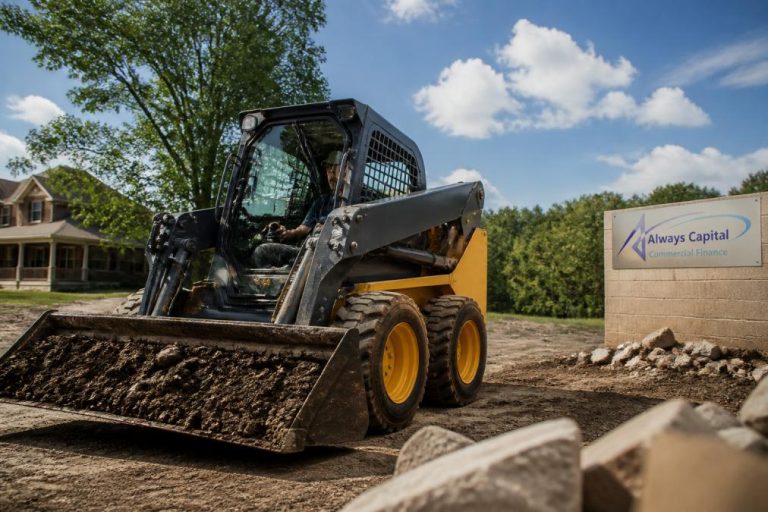
A skid steer is a compact, rigid-frame loader that turns by driving its left and right wheels at different speeds, letting it spin in place on a driveway, squeeze between a house and a fence line, and still lift a full bucket of dirt. This guide from Always Capital covers what a skid steer does, which specs decide whether a used unit is worth buying, and how skid steer financing gets one onto a job site without draining working capital.
The machine earns its keep through attachment versatility: a single carrier runs a bucket, forks, auger, breaker, sweeper, or grapple, often replacing two or three dedicated machines. A common mistake is buying on lifting capacity alone and ignoring hydraulic flow, the number that decides which attachments the machine can run.
Key Components: Lift Arms, Hydraulics, and the Operator Station
Three systems define how a skid steer performs. The lift arms raise and lower the attachment and come in radial or vertical configurations: radial lift keeps the load closer at mid-height for digging and grading, while vertical lift keeps the bucket farther forward as it rises for loading trucks and stacking pallets.
The hydraulic system powers both the drive motors and the attachment circuit. Standard-flow machines run buckets and forks; high-flow machines run cold planers, trenchers, and forestry mulchers. The operator station sits between the lift arms, with joystick or hand-and-foot controls, a suspension seat, and a ROPS/FOPS cab that protects against rollover and falling debris.
Why It Is Called a Skid Steer
The name describes the steering mechanism. A skid steer has no steering axle: to turn, the operator slows or stops the wheels on one side while the other keeps driving, so the tires skid across the surface. That design produces a zero-turn radius and a very short wheelbase, both of which matter on cramped sites. The trade-off is tire wear and surface scuffing on finished pavement, which is why many crews add tracks or turf tires for landscaping work.
Skid Steer Specs That Matter on the Job Site
Manufacturer spec sheets bury the numbers that decide whether a machine fits the work. Four figures matter most: operating capacity, tipping load, breakout force, and hydraulic flow. Read the first three together, because a machine that lifts a heavy pallet may still struggle to break compacted soil.
Operating Capacity, Tipping Load, and Breakout Force
Operating capacity is the safe working load, typically set at roughly half the machine’s tipping load to keep the rear wheels planted. Tipping load is the point at which the machine would tip forward with a raised load. Breakout force measures how hard the bucket can pry material loose, determining whether the machine can cut into packed gravel or clay.
A practical rule: match operating capacity to the heaviest routine load, not the heaviest load the machine will ever see. Operators who run at the tipping limit every day wear out lift cylinders and stress the undercarriage faster than the maintenance schedule assumes.
Hydraulic System, High-Flow Options, and Attachment Compatibility
Hydraulic flow, measured in gallons per minute, sets the attachment ceiling. Standard-flow machines handle buckets, forks, grapples, and augers. High-flow machines add enough flow to run trenchers, cold planers, and mulching heads that need continuous power at the attachment.
The quick attach plate is the other half of compatibility. Most modern carriers use a universal mounting pattern, so attachments move between machines from different manufacturers. Confirm flow and pressure ratings before buying an attachment, because a high-flow head on a standard-flow carrier will stall under load.
Spec | What It Controls | Why It Matters |
|---|---|---|
Operating capacity | Safe working load | Prevents tip-overs |
Tipping load | Forward stability limit | Sets the real ceiling |
Breakout force | Digging power | Cuts compacted material |
Hydraulic flow | Attachment power | Decides high-flow needs |
Ground speed | Travel pace | Affects cycle times |
Common Skid Steer Uses Across Construction and Landscaping
Grading crews, paving companies, and landscapers run skid steers because the machine handles the small tasks that would waste an excavator’s day. The real value is the attachment matrix: a single carrier with the right attachments replaces two or three dedicated machines, and knowing which attachment fits which job separates a productive skid steer from an expensive one sitting in the yard.
Attachment-to-Task Mapping
Attachment | Primary Job | Flow Requirement | Notes |
|---|---|---|---|
Bucket | Dig, load, backfill, grade | Standard | The default; tooth or smooth edge changes the cut |
Forks | Pallets, pipe, lumber, block | Standard | Lifts more than a bucket at the same capacity |
Grapple | Brush, debris, demolition cleanup | Standard | Root rake version handles land clearing |
Auger | Fence posts, footings, tree planting | Standard | Down-pressure matters more than flow |
Trencher | Utility lines, drainage, irrigation | High-flow | Needs continuous flow or it stalls |
Cold planer | Asphalt milling, concrete scarifying | High-flow | The attachment that forces a high-flow machine |
Forestry mulcher | Brush and small-tree clearing | High-flow | Highest hydraulic demand of any common attachment |
Breaker | Concrete, rock, frost | Standard | Impact tool; cycle time beats raw flow |
Sweeper | Parking lots, road cleanup | Standard | Broom angle and down-pressure drive results |
Construction and Site Work
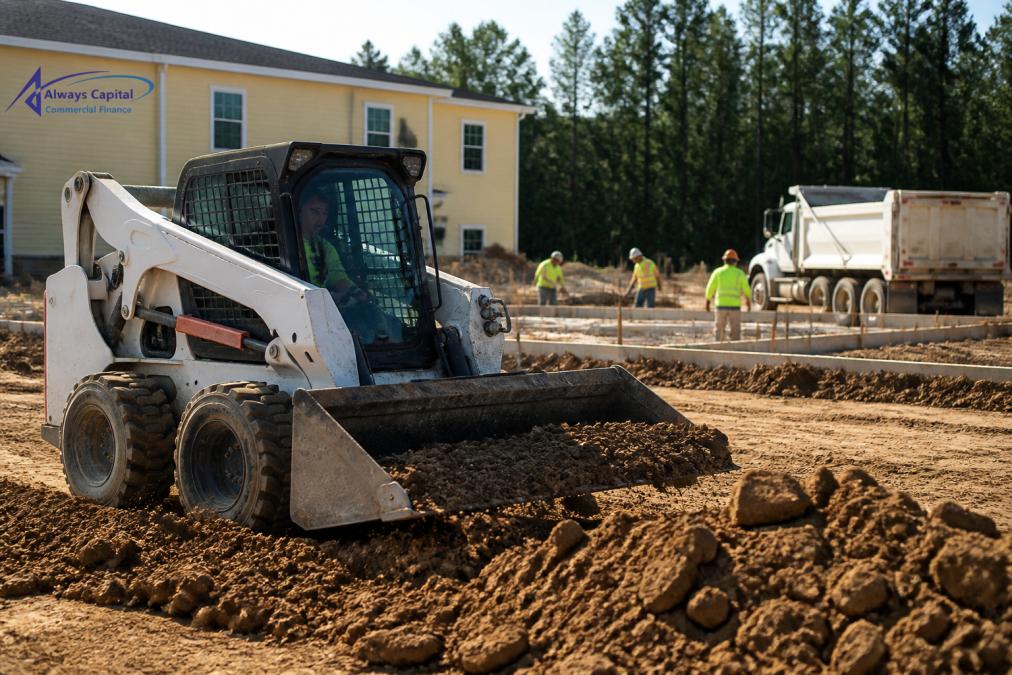
On a residential site, a skid steer strips topsoil, grades a driveway base, and moves pallets of pavers without tearing up the lawn. On commercial work, the same carrier sweeps parking lots, runs a breaker on concrete, and loads spoil into a dump truck. The short wheelbase and tight turning radius are why the machine exists in these settings, a full-size loader cannot reach a backyard or a parking garage interior.
Landscaping and Specialty Work
Landscaping crews lean on the platform for auger work, stump grinding, and spreading mulch in tight backyards. A turf-tire or track machine protects finished lawns that a wheeled machine on standard tires would rut. Snow removal is a seasonal revenue stream: a skid steer with a snow blade or angle broom clears sidewalks and small lots a full-size plow truck cannot fit into.
The Cost-of-Ownership Angle Most Buyers Miss
Spec sheets sell machines; the ownership math determines whether the purchase pays off. Three cost drivers matter more than the sticker:
- Fuel burn: a skid steer runs a small diesel at high load, so fuel consumption tracks how hard the machine works, not how far it travels. Idling between tasks burns fuel without producing revenue.
- Undercarriage and tires: wheeled machines wear tires fast on pavement; track machines wear tracks and sprockets. The wear item depends on the surface, not the brand.
- Attachment investment: a high-flow machine opens the door to trenchers, planers, and mulchers, but each attachment is a separate capital item. Planning the attachment list up front avoids buying a second carrier later.
Maintenance, Safety, and Operator Training Essentials
A skid steer is a high-vibration, high-cycle machine, and most of its expensive failures start as cheap ones that went unnoticed. The routine below is what most fleet mechanics treat as the baseline, and it doubles as a troubleshooting checklist for owners buying a used unit.
Daily and 50-Hour Checks
Before every shift: walk the machine, check engine oil and coolant, drain the water separator, inspect the hydraulic reservoir sight glass, and look for fresh fluid trails under the lift arm pivots and drive motors. Every 50 hours: grease the lift arm pins, tilt cylinder ends, quick attach plate, and axle pivot points. Skipping grease on the quick attach is the most common cause of a stuck attachment on a used machine.
250-Hour and Annual Service
At roughly 250 hours, most manufacturers call for an engine oil and filter change, a hydraulic filter change, a fuel filter change, and an inspection of the drive belts and battery terminals. Annually, regardless of hours, service the air filter, check the cooling system for debris packed into the radiator (a chronic issue on machines that run in mulch or hay), and inspect the ROPS mounting bolts for cracks. Track loaders add a separate schedule: check track tension every 50 hours and re-torque track bolts at the manufacturer’s interval, because a loose track will derail under a side load.
Troubleshooting Common Failures
- Sluggish or weak lift and tilt: usually a clogged hydraulic filter, low fluid, or a worn pump. On load-sensing systems, a dirty filter shows up as slow attachment response long before the pump fails.
- Attachment stalls under load: almost always a flow mismatch, a high-flow head on a standard-flow carrier, or a quick-coupler that is not fully seated.
- Machine pulls to one side: check tire pressure and tread depth first, then the drive motor on the weak side. Uneven tire wear is the most common cause and the cheapest to fix.
- Overheating: debris in the radiator and hydraulic cooler, low coolant, or a failing fan drive. Clean the coolers with compressed air, not a pressure washer, to avoid bending fins.
- Track derailment on a track loader: usually low track tension or a worn sprocket. Re-tension per the manual before replacing parts.
Safety and Operator Training
ROPS and FOPS structures protect the operator only when the seat belt is fastened, an unbelted operator can be thrown from the cab in a tip-over, the leading cause of skid steer fatalities. Side-entry systems on newer cabs reduce the risk of climbing over a raised bucket, a common injury path on older machines.
The OSHA guidance on powered industrial equipment treats operator training as an employer obligation, and the NIOSH research on [heavy equipment(/blog/application-only-heavy-equipment-financing-1/) safety | cdc.gov] documents how quickly a tip-over turns fatal without a fastened restraint. A practical training program covers: pre-shift inspection, load charts and operating capacity limits, travel on slopes (always up and down, never across, with the heavy end uphill), seat belt use, and shutdown and parking procedure. New operators should log supervised hours on a flat, open pad before working a slope or a tight residential lot.
Heavy Equipment Financing for Skid Steers and More
Budgeting for a skid steer means planning the purchase, not just the sticker. Heavy equipment financing spreads the acquisition across a term that matches how the machine earns, keeping cash available for payroll, fuel, and materials. Always Capital structures heavy equipment financing for skid steers alongside excavator financing, backhoe financing, loader financing, bulldozer financing, and dump truck financing.
The practical advantage of financing over paying cash is cash flow. A skid steer that runs five days a week generates revenue from the first week, while a cash purchase drains the reserve a contractor needs for a slow month. Always Capital offers 100% financing, terms from 24 to 84 months, and deferred payment plans of 30, 60, or 90 days, so the first payment can land after the machine is already producing.
Business Equipment Leasing as a Flexible Alternative
Business equipment leasing works like financing but with a different endgame. Instead of owning the machine outright at the end of the term, the business makes scheduled payments for use of the equipment and decides at the end whether to return, renew, or buy it out.
Leasing also fits seasonal work. Always Capital offers business equipment leasing alongside term loans and business lines of credit, and finances older equipment and trucks with no restrictions on age or mileage, which matters when a good used machine is the smarter buy.
Why Skid Steer Financing With Always Capital Gets You Approved Fast
Skid steer financing with Always Capital is a fast and easy way to upgrade equipment for all credit types, with same-day approvals typically inside two to four hours. Applications go through a soft credit pull, application-only approvals reach up to $500,000 with no financials required, and financing runs up to $5 million for larger fleets. Always Capital works with all credit types and accepts every application, drawing on more than 35 lending sources to place each deal.
The process is built for contractors who cannot wait a week for an answer. Businesses with challenged credit get the same shot at approval as anyone else, because the application is evaluated across multiple lending sources rather than a single set of criteria.
Financing Option | Best For | Key Feature |
|---|---|---|
Skid steer financing | One machine, long-term ownership | 100% financing available |
Heavy equipment financing | Multi-machine fleets | Up to $5 million |
Business equipment leasing | Frequent upgrades | Return, renew, or buy out |
Business line of credit | Working capital gaps | Covers payroll and operations |
Conclusion
Equipment downtime costs more than the machine itself, and waiting on a slow approval can push a start date back by weeks. Always Capital closes that gap with same-day approvals in two to four hours, 100% financing, application-only approvals up to $500,000 with no financials, and support for all credit types. Get started with Always Capital and put a skid steer to work on the next job.
Frequently Asked Questions
Why is it called a skid steer?
A skid steer gets its name from how it turns. Instead of using a traditional steering system, it skids or drags its wheels on one side while the other side keeps moving, which lets it pivot in place. That skidding mechanism is what gives the machine its tight turning radius and maneuverability in cramped job sites where larger equipment cannot fit.
What is the purpose of a skid steer on a job site?
A skid steer handles digging, grading, hauling, and lifting with quick attach attachments that swap in minutes. Common uses include moving dirt and gravel, clearing debris, trenching, and loading trucks. Its compact size and vertical or radial lift arms make it useful for landscaping, paving, and general construction where space is tight and cycle times matter.
Can I get skid steer financing with less-than-perfect credit?
Yes. Always Capital works with all credit types and accepts every application. We offer application-only approvals up to $500,000 with no financials required, and 100% financing options are available. Whether you have challenged credit or a strong profile, you can apply and get a decision, often within two to four hours.
How quickly can I get approved for heavy equipment financing?
Always Capital provides same-day approvals in as little as two to four hours. The process uses a soft credit pull, so checking your options does not affect your credit score. Once approved, you can move forward with deferred payment plans of 30, 60, or 90 days and loan terms from 24 to 84 months.