
Table of Contents
- What Lenders Actually Review in Your Heavy Equipment Loan File
- Heavy Equipment Financing Requirements: The Core Documents You Need
- Why Business Bank Statements for Loans Carry So Much Weight
- Proof of Business Ownership for Financing: Getting the Paperwork Right
- The Equipment Financing Application Process, Step by Step
- How to Prepare Your Documents for a Heavy Equipment Loan
- Common Reasons Applications Stall or Get Denied
- Conclusion
- Frequently Asked Questions
Last Updated: September 10, 2026
What Lenders Actually Review in Your Heavy Equipment Loan File
A heavy equipment loan application lives or dies on documentation. Lenders read your file to answer one question: can this business carry a monthly payment while the machine earns? The essential documents for heavy equipment loan approval are the records that prove identity, ownership, cash flow, and the asset itself. This guide from Always Capital breaks down each one, in the order underwriters actually review them.
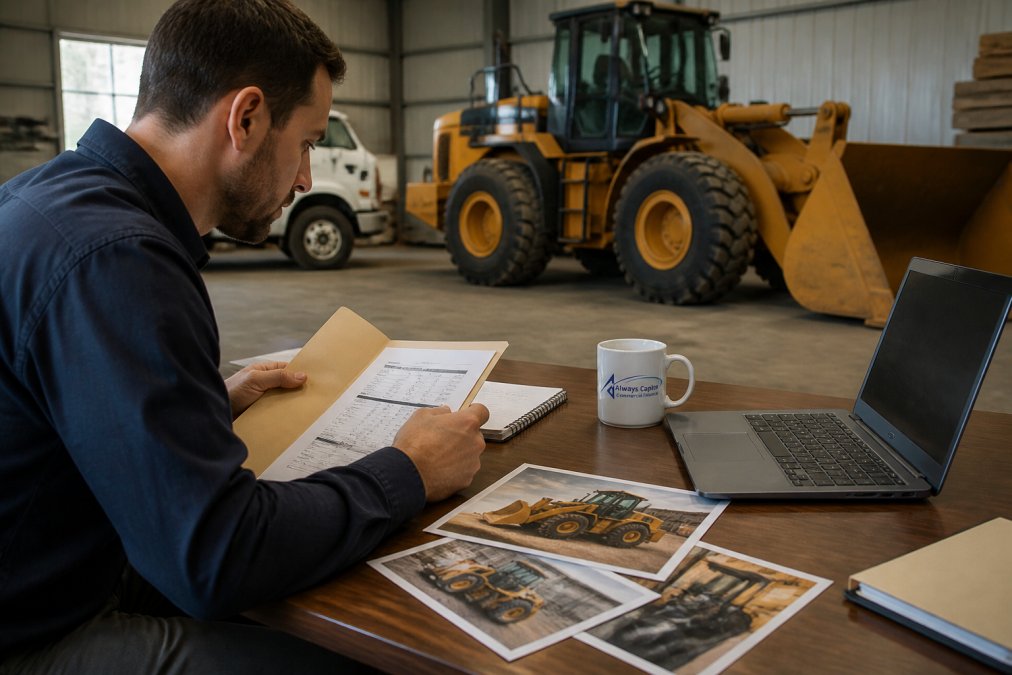
Most applicants assume the machine matters most. It doesn’t. The equipment is collateral; the paperwork is the story of whether you can pay for it. Underwriters weigh four things: who you are, what you own, how money moves through the business, and what you’re buying. Every document below exists to answer one of those four questions.
That framing matters because it changes how you assemble the file. You’re not gathering paper. You’re building an argument.
Heavy Equipment Financing Requirements: The Core Documents You Need
Heavy equipment financing requirements fall into two buckets: records that establish the business and records that prove it can pay. Missing either bucket stalls the file, no matter how strong the other side is.
| Category | Documents | What It Proves |
|---|---|---|
| Identity | Driver’s license, EIN letter | You are who you say |
| Formation | Articles, operating agreement | The business legally exists |
| Ownership | Business license, ownership certificate | Who controls the entity |
| Financials | Bank statements, equipment quote | Cash flow and collateral |
| Equipment | Invoice, spec sheet, photos | What’s being financed |
Ask for the equipment invoice before you apply. A written quote with the dealer’s name, the machine’s year, make, model, and serial number speeds underwriting more than any other single page.
Identity and Business Formation Records
Every file starts with a government-issued ID for each owner holding 20% or more of the business, plus the letter confirming the entity’s EIN. Formation documents come next: articles of incorporation or organization, and the operating agreement or bylaws naming who can sign.
Lenders pull these to confirm the entity is active and in good standing. An expired registration or a missing signature block is one of the most common reasons a file sits untouched for days.
Financial Records and Equipment Details
Financial records prove repayment capacity. Equipment details prove collateral value. Together they form the backbone of the file.
- Recent business bank statements, typically three to six months
- The equipment invoice, quote, or purchase agreement
- Year, make, model, and serial number for the unit
- Photos of the machine, if it’s used
Used equipment adds one wrinkle: the lender wants to know the asset holds value. That’s where serial numbers and photos earn their place.
Why Business Bank Statements for Loans Carry So Much Weight
Business bank statements for loans do more work than any other document. They show deposits, balances, and how consistently money moves through the account. A lender reading three months of statements can see whether revenue is steady, seasonal, or erratic.
Statements also reveal red flags: overdrafts, returned items, or deposits that don’t match the story on the application. Consistency matters more than size. A business depositing steadily each week reads stronger than one with a single large deposit and quiet months after.
Don’t move money between accounts to make statements look fuller. Underwriters read patterns, and round-trip transfers between your own accounts are easy to spot. It slows the file and raises questions you’ll have to answer.
For application-only programs, statements may not be required at all. Always Capital offers application-only approvals with no financials required on qualifying amounts, which shortens the process considerably.
Proof of Business Ownership for Financing: Getting the Paperwork Right
Proof of business ownership for financing establishes who legally controls the entity and who can sign the loan. Lenders typically want a business license, a certificate of formation, and the ownership section of the operating agreement listing members and their percentages.
Sole proprietors have it simpler: a business license and a Schedule C from the most recent filing usually suffice. Corporations and LLCs need the full formation package.
One detail trips up a lot of applicants. If the person signing the application isn’t listed as an authorized signer in the operating agreement, the lender will ask for a resolution or addendum. Getting that page in the file upfront saves a round trip.
The Equipment Financing Application Process, Step by Step
The equipment financing application process moves in four stages, and each one depends on the paperwork from the last.
- Submit the application. Basic business details, the equipment you’re buying, and the amount you need.
- Soft credit review. The lender reviews your credit profile without a hard inquiry.
- Document collection. The lender requests whatever the file still needs, from bank statements to the equipment invoice.
- Underwriting and decision. The lender verifies the documents, confirms collateral value, and issues terms.
Approval speed depends on which path you take. Application-only files move fastest because there’s less to verify. Fully documented files take longer but often support larger amounts.
Application-Only vs. Full Documentation
Application-only financing skips bank statements and financial statements in favor of credit profile and business details. It’s the faster path, and it suits businesses that need equipment working on site quickly. Full documentation trades speed for capacity: bank statements, financial statements, and sometimes a personal guarantee support larger amounts and longer term lengths.
The trade-off is straightforward. If the amount you need fits within an application-only limit, take the faster route. If it doesn’t, the extra paperwork buys you funding capacity you can’t get otherwise.
How to Prepare Your Documents for a Heavy Equipment Loan
Preparation is where most applicants either save a week or lose one. The work is unglamorous and entirely within your control.
- Confirm the entity is active and in good standing with the state
- Pull three to six months of business bank statements as PDFs
- Get the equipment invoice with year, make, model, and serial number
- Collect IDs for every owner above 20%
- Check that the operating agreement names the signer
- Save everything in one folder, named clearly
A complete file is the single biggest lever on approval speed. Lenders don’t decline complete applications; they decline ones they can’t finish reading.
If you’re financing used equipment, add photos and any service records. Always Capital finances older equipment and trucks with no restrictions on age or mileage, so a well-documented older machine is still a strong candidate.
Common Reasons Applications Stall or Get Denied
Files rarely get denied outright. They stall, and stalling is usually about gaps rather than weaknesses. But some gaps are fixable in an afternoon and some require a different approach entirely. Knowing which is which is the difference between a same-week approval and a file that goes quiet.
The Fixable Stalls
These are the issues that stop underwriting temporarily and clear once you supply the missing piece:
- Ownership mismatch. The operating agreement lists members and percentages that don’t match the application. Underwriting pauses until the entity documents and the application agree.
- Missing signature authority. The person signing isn’t named as an authorized signer. A resolution or addendum from the entity fixes it.
- Expired entity registration. The business isn’t in good standing with the state. Reinstatement is usually a same-day filing.
- Equipment quote mismatch. The amount requested doesn’t match the invoice, or the invoice is missing year, make, model, or serial number. A corrected dealer quote clears it.
- Thin or inconsistent bank statements. Real revenue but messy deposits. A written explanation of large or irregular deposits often resolves it.
None of these are credit issues. They’re paperwork issues, and they’re the reason a complete file moves faster than a strong-but-incomplete one.
The Harder Stalls
These take longer to resolve because they involve the business profile rather than a single document:
- Short time in business. A business with limited operating history has less history for the lender to read. The file shifts weight onto the signer’s personal credit profile and the collateral.
- Recent derogatory credit events. A recent bankruptcy, judgment, or collection changes how the lender reads the file. It doesn’t automatically disqualify, but it moves the application toward full documentation, where bank statements can demonstrate current cash flow.
- Deposit patterns that don’t match the stated revenue. If the application says one thing and the statements say another, underwriting has to reconcile the difference before it can proceed.
- Collateral that’s hard to value. Older, high-hour, or uncommon equipment takes longer to verify. Photos, hour-meter readings, and service records shorten the process.
What Actually Causes a Denial
Outright denials cluster around a few patterns:
- No verifiable business entity. The lender can’t confirm the business legally exists or who controls it.
- No path to repayment. The business profile and the signer’s credit together don’t support the requested amount, and there’s no documentation to close the gap.
- Collateral the lender can’t underwrite. The equipment can’t be verified, valued, or titled in a way the lender can secure.
- Unresolved discrepancies. The application, the documents, and the equipment quote tell three different stories, and the applicant can’t reconcile them.
Notice what’s not on that list: a low credit score by itself. Most programs work with a range of credit profiles, and a challenged profile is a routing decision, not a rejection.
Don’t submit an application with documents you know are inconsistent and hope underwriting won’t notice. Reconciling a discrepancy after submission takes longer than explaining it upfront, and it puts the file in a slower review queue.
How to Recover From a Stall
If your file goes quiet, the recovery path is almost always the same:
- Ask the lender exactly which document is outstanding. “What’s missing?” gets a faster answer than “What’s the status?”
- Supply the missing piece as a single clean PDF, not a phone photo of a printout.
- If the issue is the business profile rather than a document, ask whether the full-documentation path is available. Bank statements can often carry a file that application-only can’t.
- If the equipment is the problem, get a fresh dealer quote with full specs and, for used units, current photos.
A stall is a request for information, not a decision. The applicants who get approved fastest are the ones who treat every underwriting question as a to-do item and close it the same day.
Always Capital works with all credit types and accepts all applications, and finances older equipment and trucks with no restrictions on age or mileage. If your file has a gap, the fastest move is to name it upfront rather than let underwriting find it.
Conclusion
Assembling the essential documents for heavy equipment loan approval isn’t the hard part of financing. Knowing which pages matter and why is. Get identity, ownership, financials, and equipment details into one clean file, and underwriting has everything it needs to say yes.
Frequently Asked Questions
What documents are typically required for a heavy equipment loan?
Most lenders ask for a completed application, a government-issued ID, business formation documents, and proof of business ownership. For full-documentation files, you will also provide business bank statements, financial statements, and equipment details such as make, model, year, and condition. Application-only programs can approve requests up to $500,000 with no financials required, which shortens the document list considerably.
How long does the heavy equipment loan approval process take?
Timelines depend on how much documentation the lender requests. Application-only approvals can move quickly, with some decisions in as little as two to four hours. Full-documentation files take longer because bank statements, financial statements, and equipment details all need review. Having your documents organized before you apply is the single biggest factor in how fast your heavy equipment loan moves through approval.
Can I get approved for heavy equipment financing with bad credit?
Yes. Many lenders work with all credit types, including challenged credit profiles. Strong business bank statements, a solid down payment, and equipment that holds value can offset a lower business credit score. Some programs also approve applicants with no financials required up to $500,000. The key is being upfront about your credit profile so the lender can match you with the right program.
What if I need more than the application-only limit?
When your request exceeds the application-only threshold, lenders typically move to a full-documentation review. That means submitting business bank statements, financial statements, and possibly a personal guarantee. The equipment itself also serves as collateral, which supports larger funding amounts. Ask your lender early which tier your request falls into so you can gather the right paperwork before the review begins.
When a machine is sitting on a lot and the job starts next week, paperwork shouldn’t be what slows you down. Always Capital offers same-day approvals in as little as two to four hours, 100% financing options, and application-only approvals with no financials required on qualifying amounts. Terms run 24 to 84 months, with deferred payment plans of 30, 60, or 90 days available. Get started with Always Capital and put your equipment to work.