

Table of Contents
- Why Winter Inventory Makes Now the Best Time for Roll Off Truck Financing
- Roll-Off Truck Financing With Always Capital: Two-Hour Approvals, All Credit Types
- Roll-Off Dumpster Truck Types and the Manufacturers Behind Them
- Used Roll-Off Truck Financing With No Age or Mileage Restrictions
- Deferred Payment Equipment Financing to Protect Cash Flow
- Industries That Run Roll-Off Trucks and How Always Capital Helps You Grow
- What to Compare When Choosing a Roll-Off Truck Financing Company
- Conclusion
- Frequently Asked Questions
Last Updated: October 20, 2026
Why Winter Inventory Makes Now the Best Time for Roll Off Truck Financing
Dealers across the country are working through year-end floorplan pressure right now, and that changes the conversation for anyone shopping roll off truck financing.
Always Capital has helped waste and refuse operators lock in equipment before the seasonal squeeze hits.
Below, we’ll show you exactly how to time a purchase, which truck types fit which routes, and how to prepare an application that gets approved fast.
Roll-Off Truck Financing With Always Capital: Two-Hour Approvals, All Credit Types
Roll off truck financing through Always Capital moves on a two-hour approval window, with all credit types accepted and every application reviewed. That speed matters when a dealer has a unit priced to move and three other buyers circling.
The program covers up to 100% financing, so a qualified operator can add a truck without draining working capital. Applications are accepted from every credit profile, and the process uses soft pulls only, which means your credit is not affected by applying.
Programs Built for Waste and Refuse Operators
Refuse work is seasonal, route-driven, and hard on equipment. Always Capital builds payment structures around that reality, with terms from 24 to 84 months and deferred payment plans of 30, 60, or 90 days.
Application-only approvals are available up to $500,000 with no financials required. Larger requests move through a fuller review, and the team walks applicants through what’s needed before submission rather than after a denial.
Soft Pulls Only and 100% Financing
Soft pulls only is the detail that surprises most first-time applicants. Checking your options does not ding your credit score, so there is no penalty for comparing structures before committing.
Combined with 100% financing, that removes two of the biggest friction points in equipment buying: the credit inquiry and the down payment. Consumer Financial Protection Bureau guidance on credit inquiries explains how soft inquiries differ from hard pulls, which is worth understanding before any application.
Roll-Off Dumpster Truck Types and the Manufacturers Behind Them
Roll-off trucks are a chassis plus a mounted body, and the body, not the badge on the grille, is what determines what the truck can haul. Understanding both halves is the difference between buying a unit that fits your routes and buying one that sits idle.
The Two Body Designs: Cable Hoist and Hooklift
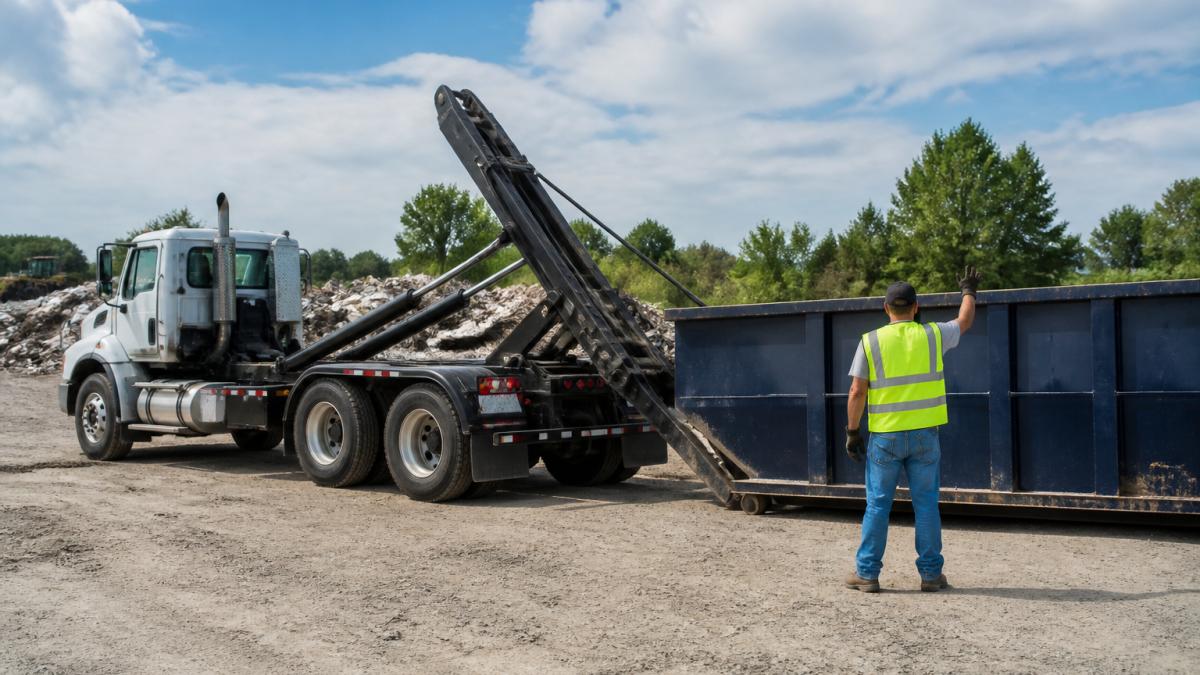
Cable hoist trucks use a winch and cable to drag the container up a tilted frame.
Hooklift systems use a hydraulic hook and tilt frame to lift and set containers. The advantage is container flexibility, one truck can carry 12-, 15-, 20-, and 30-yard boxes and swap them in minutes.
A third, less common option is the roll-off trailer, which lets a tractor pull containers without dedicating a straight truck to the work.
Body Builders That Matter
The chassis gets the attention, but the hoist body is where roll-off trucks are actually specified. Well-known body builders include Galbreath, Heil, Marathon, Accurate, Dragon, and Wastequip.
When you finance a roll-off truck, confirm the body builder, the hoist capacity rating, and the container sizes the body is rated for. A truck with a mismatched body and chassis is a collateral problem as much as an operational one.
Chassis Manufacturers and What Each Brings
On the chassis side, common refuse specs include Mack, Peterbilt, Kenworth, Freightliner, International, and Volvo.
Matching the Truck to the Route
Feature | Cable Hoist | Hooklift |
|---|---|---|
Container flexibility | Single size focus | Multiple sizes |
Swap speed | Slower | Faster |
Maintenance complexity | Lower | Higher |
Best for | Transfer stations, long hauls | Multi-site collection |
Typical container range | 20-40 yards | 12-30 yards |
Pick cable hoist if your routes are long-haul transfer runs with consistent container sizes. Pick hooklift if you serve multiple customer sites with mixed container needs and need fast swaps. Either way, Always Capital finances the chassis and the mounted body together, and can bundle dump truck financing and heavy equipment financing into the same relationship if you are adding support equipment.
Used Roll-Off Truck Financing With No Age or Mileage Restrictions
Used roll-off trucks carry no age or mileage restrictions under Always Capital’s program, which opens a market most lenders shut.
Older equipment and trucks are financeable here, including auction purchases with pre-approval arranged before the sale.
APPLY NOW AND GET YOUR BUSINESS PRE-APPROVED FOR FINANCING TODAY ! →
A common mistake is assuming a high-mileage truck is unfinanceable. In practice, the condition of the hoist and frame matters more than the odometer, and lenders who understand refuse equipment price it accordingly.
Deferred Payment Equipment Financing to Protect Cash Flow
Deferred payment equipment financing lets a hauler take delivery now and start payments 30, 60, or 90 days later. For a business adding a truck ahead of a busy season, that gap covers the ramp-up period when the truck is working but receivables haven’t caught up.
Cash flow protection is the real benefit. A truck that starts earning in month one but doesn’t require a payment until month three gives the operator breathing room to hire a driver, register the unit, and build the route.
Industries That Run Roll-Off Trucks and How Always Capital Helps You Grow
Roll-off service is the backbone of debris removal, and the industries that depend on it each buy trucks for different reasons. Understanding those reasons is how an operator decides which truck to add next, and how to finance it without starving the rest of the business.
Who Runs Roll-Off Trucks
- Construction, new builds and remodels generate framing debris, drywall, and packaging that need 20- to 40-yard containers. Demand tracks the building cycle and peaks in warmer months.
- Demolition, heavy debris and concrete require reinforced containers and trucks rated for dense loads. Cable hoist units are common here because container sizes stay consistent.
- Roofing, tear-off shingles are heavy and volume-heavy, and roofing crews need fast swaps between job sites. Hooklift trucks fit because one unit can service several roofs a day.
- Municipal and county waste departments, route-based collection with fixed container inventories, often spec’d on Mack or Freightliner chassis for parts commonality.
- Scrap yards and recycling, metal and paper volumes fluctuate with commodity markets, so container flexibility and truck reliability matter more than peak capacity.
Each of these has a different seasonality curve, and each needs a truck spec that matches its container mix. A roofing-focused hauler and a demolition hauler may both run roll-off trucks, but they should not buy the same one.
How Always Capital Helps You Grow the Business
Growth in refuse work comes from route density and container count, not from one truck working harder. Always Capital finances the full range of equipment a growing hauler needs, from dump truck financing for debris hauling to excavator financing for site work and skidsteer financing for tight-site cleanup.
Fleet expansion capital is the lever most operators ask about. Adding a second or third truck multiplies route capacity, and financing preserves the working capital needed for containers, fuel, and payroll.
Deferred payment structures of 30, 60, or 90 days matter here too. A hauler adding a truck ahead of a busy season can align the first payment with the revenue that truck generates, which protects cash flow during the ramp-up.
What to Compare When Choosing a Roll-Off Truck Financing Company
Approval speed, credit flexibility, down payment requirements, and term length separate good financing partners from slow ones. A company that quotes two-hour approvals and delivers them is worth more than one quoting the lowest headline number and taking two weeks.
Ask every provider four questions: How fast is approval? Are soft pulls used? Is 100% financing available? Are there age or mileage limits on used units? The answers sort the field quickly.
Application Checklist and Approval Preparation
- Business legal name, entity type, and formation date
- EIN and business address
- Truck details: year, make, model, body type, VIN or listing
- Dealer or seller contact information
- Desired term length and deferred payment preference
- Owner identification and contact details
Gather these before applying and a two-hour approval is realistic. Missing items are what stretch timelines.
Conclusion
The window between now and year-end is when dealers discount to clear inventory, and the operators who move with pre-approval in hand capture those units.
Always Capital approves in two to four hours, accepts all credit types, uses soft pulls only, and offers up to 100% financing with deferred payment options.
Get pre-approved for roll off truck financing with Always Capital and put a truck on the road before the season turns.
Frequently Asked Questions
Can you finance a roll-off truck with bad credit?
Yes. Always Capital works with all credit types and accepts all applications, so a rough credit history does not automatically disqualify you. The application uses a soft credit pull only, which means checking your options does not hurt your credit score. Approval decisions focus on the equipment as collateral and your business revenue rather than a single credit number. Businesses with challenged credit often pair a larger down payment or a newer truck with the request to strengthen the file. Get pre-approved to see what your business qualifies for.
Can a business finance a used roll-off truck?
Yes. Used roll-off truck financing is a core part of the program, and Always Capital finances equipment with no age or mileage restrictions. That matters in waste hauling, where a well-maintained 2015 chassis with a rebuilt hoist can still run profitable routes for years. Lenders that cap age or mileage force operators into newer, costlier units. Bring the truck’s year, make, model, mileage, and hoist type to the application. Approval can come in as little as two to four hours, so a used unit at a dealer lot does not sit long enough to sell to another buyer.
What types of roll-off trucks are available to finance?
The two main roll-off dumpster truck types are cable hoist and hooklift. Cable hoist trucks use a winch and cable to drag containers onto the frame and dominate heavy demolition and construction debris hauling. Hooklift trucks use a hydraulic hook and tilting subframe, handle a wider range of container lengths, and suit operators who swap bodies for different jobs. Builds come from manufacturers including Mack, Peterbilt, Kenworth, Freightliner, Volvo, and International, with various hoist systems. Always Capital finances all of these configurations, new or used.
Can roll-off truck financing include deferred payments?
Yes. Deferred payment equipment financing lets you push the first payment out 30, 60, or 90 days, which gives a new truck time to start earning before the payment schedule begins. It fits waste operators who are adding a truck ahead of a busy season or waiting on a new contract to ramp up. The deferral is built into the term structure, not a balloon that hits later, and Always Capital walks you through the exact schedule before you sign. Ask about it during the application so the structure is set correctly from the start.
The challenge is timing: inventory clears fast and the best units go to buyers who are already approved. Always Capital solves that with two-hour approvals, 100% financing, soft pulls only, and deferred payment plans built for seasonal cash flow. Get started with Always Capital and add the truck your routes need.