
Last Updated: November 17, 2026
Quick Summary
Manual grading is cutting and trimming a surface to grade using only the operator’s judgment, control coordination, and reference points, with no grade-control system correcting the bucket. It is slower than automation and, in the right hands, remarkably accurate. When a sensor fails or a receiver loses signal, the operator who can finish by eye keeps the crew working.
- Machine feel develops slowly through repetition, correction, and digging badly until the bucket does what you meant.
- The feedback loop runs on three readable channels: sound, vibration, and hydraulic response.
- A frozen display leaves operators without a reference point, so teach hub stakes, stringlines, and known elevations.
- Train apprentices with grade control off first, then add the screen as a checker, not a crutch.
- Crews that practice manual passes monthly stay sharp when the tech blinks.
Table of Contents
- Why the Feel Operator Is Vanishing from the Seat
- Manual Grading with an Excavator: The Skills Automation Can’t Replace
- From Cable Controls to Grade Control: A Short, Funny History
- Excavator Operator Training That Builds Judgment, Not Just Button Pushing
- When the Tech Blinks: Drills That Keep Manual Skills Sharp
- Financing New or Used Iron So the Skill Has a Machine to Sit In
- Frequently Asked Questions
Why the Feel Operator Is Vanishing from the Seat
The seat is still there. The hands that knew what to do with it are retiring. This guide from Always Capital looks at what manual grading with an excavator demands, why automation is quietly erasing it, and how crews can keep the skill alive.
No screens. No satellites. Just levers, clutches, and brakes that fought back, and a machine response you learned to predict like a friend’s moods.
What Machine Feel Actually Is (and How It Develops)
Machine feel is the operator’s ability to read vibration, sound, and hydraulic response and translate that into precise control input without consulting a display. It develops slowly, through repetition, correction, and the small humiliations of digging badly until the bucket finally does what you meant.
Manual Grading with an Excavator: The Skills Automation Can’t Replace
Manual grading with an excavator is cutting and trimming a surface to grade using only the operator’s judgment, control coordination, and reference points, with no grade-control system correcting the bucket.
Feel is more than nostalgia. It is a safety and productivity asset. When a sensor fails mid-pour or a receiver loses signal, the operator who can finish by eye keeps the crew working.
The Feedback Loop That Makes Precision Possible
Precision grading depends on a closed feedback loop that runs faster than any display refresh. The operator feeds input through the joysticks, the machine answers with sound, vibration, and hydraulic tone, and the operator adjusts before the bucket drifts.
The loop has three readable channels, and each one teaches something different:
- Sound. Engine load tells you how hard the bucket is working before the display updates. A lugging engine means you are asking too much; a sudden lightening means you just broke through the cut.
- Vibration. The seat and joysticks transmit ground contact. A steady hum is a clean cut; a chatter means the teeth are skipping and the grade is about to go ugly.
- Hydraulic response. The lag between joystick input and boom movement is the machine’s tell. Learn the lag on your own machine and you can start the boom a beat early, the entire secret of smooth grading.
That loop is also the best operator training tool ever built. An apprentice who spends seat time learning machine response develops judgment that transfers to every machine on the worksite, the dozer, the loader, the backhoe, even the skid steer everyone pretends is easy until they try to finish a slope with it.
When the Screen Goes Dark: What Actually Gets Lost
The failure modes are predictable, which is good news, because predictable problems can be drilled. A common pattern: the grade-control receiver loses satellite lock under a bridge deck or beside a tall retaining wall, the display freezes or throws a fault, and the operator who has never cut grade by eye has no reference point to fall back on.
What gets lost in that moment is not just speed. It is the ability to establish a reference, a hub stake, a stringline, a known elevation on a curb, and work from it.
Timing, Anticipation, and Reading Machine Response
For crews building that skill, the practical takeaway is simple: cut grade by eye, check it, and cut again. The correction is where the skill lives, and every correction is a deposit in the account you draw on the day the screen goes dark.
From Cable Controls to Grade Control: A Short, Funny History
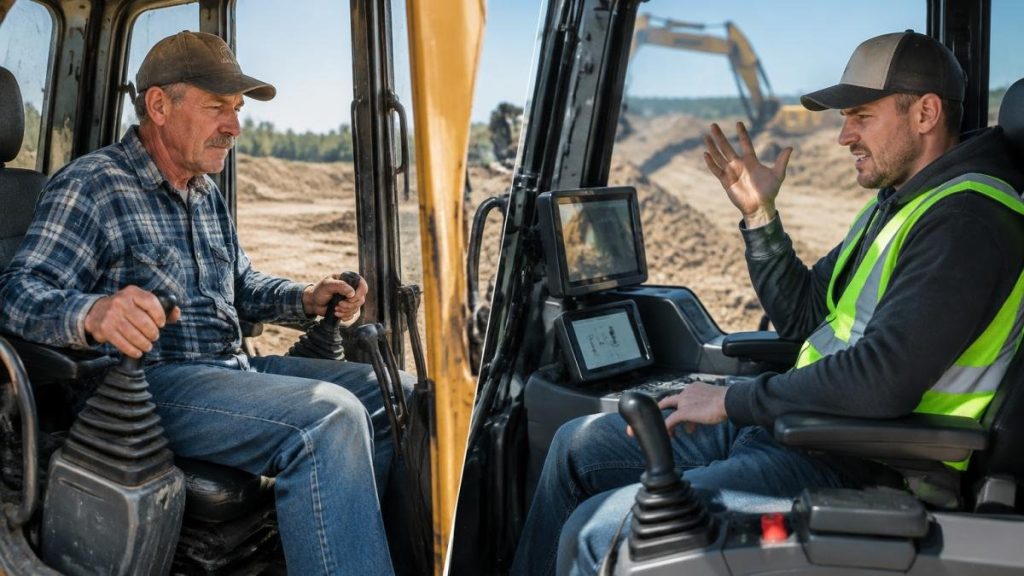
Veteran operator performing manual grading versus a frustrated young tech operator in a modern excavator cab
(/hitachi-construction-machinery-2026-equipment-guide/) traces the lineage from cable-era machines to today’s grade-control units.
Excavator Operator Training That Builds Judgment, Not Just Button Pushing
Apprentices are handed a machine with a screen on day one because the screen makes them productive faster, and productivity is what the schedule rewards. The problem is that the screen teaches the apprentice to trust the display before they have learned to trust the machine, and that order is backwards.
A Skill-Development Sequence That Actually Works
- Machine literacy without the screen. The apprentice runs the machine with grade control switched off and learns the three readable channels, sound, vibration, and hydraulic response, on flat, forgiving ground. The goal is not accuracy yet. The goal is to notice.
- Reference-based grading. The apprentice cuts to a hub stake, a stringline, or a known elevation on a curb, then checks the result with a hand level. The correction between what they intended and what they cut is the lesson.
- Screen-assisted verification. Only after the apprentice can hold grade by eye does the grade-control system come on, and it comes on as a checker, not a crutch. The apprentice cuts manually, then compares their work to the display.
- Full production with manual fallback. The apprentice runs grade control for production but rotates manual passes into every shift so the instinct keeps developing. This is the stage where feel and technology stop competing and start cooperating.
Watch out: letting an apprentice run grade control from day one builds dependency, not feel. Rotate manual passes into every training shift so the instinct keeps developing, and resist the temptation to let the screen cover for a skill that has not been built yet.
What Instructors Should Watch For
A novice who overcuts a pad stops and waits for instructions. An operator with developing feel overcuts, feels it, backs off, and feathers the correction in without being told. Instructors should watch for that recovery instinct and reward it, because it is the seed of every skill the veteran operators are about to take with them into retirement.
Pairing matters too. The veteran does not need to lecture. The apprentice just needs to watch the hands, hear the engine, and feel the machine answer.
For crews that want to keep the pipeline full, the training investment is also a financing question. Always Capital finances both new and used iron, from a used excavator for sale that makes a perfect training machine to a new unit with grade control for production work, with approvals in as little as one to three hours, soft credit pulls that leave scores untouched, and up to 100% financing. Explore Always Capital financing options to put a seat under the next operator before the veteran hands over the keys.
When the Tech Blinks: Drills That Keep Manual Skills Sharp
The best defense against skill loss is a standing drill schedule. Crews that practice manual passes monthly stay sharp when the tech blinks.
- Cut one flat pad per week with grade control switched off, then verify with a hand level
- Run a trench line by eye and check it against the receiver afterward
- Pair each apprentice with a veteran for one manual grading session per shift
These drills cost an hour and protect a career’s worth of judgment. Precision, safety, and productivity all improve when the operator can trust their hands.
Financing New or Used Iron So the Skill Has a Machine to Sit In
Skill needs a seat, and seats need funding. Whether a crew wants a used excavator for sale to train apprentices or a new machine with grade control for production work, Always Capital finances both, with approvals in as little as two to four hours and soft credit pulls that leave scores untouched.
Always Capital offers up to 100% financing, application-only approvals up to $500,000 with no financial statements, and flexible terms from 24 to 84 months.
Benefit | What It Means for Your Crew |
|---|---|
Rapid application decisions | Answers in 1 to 3 hours |
Same-day funding | Capital deployed fast |
Application-only tier | Up to $500,000, no financials |
Simplified application | Minimal paperwork |
No-impact soft credit pulls | Scores stay protected |
All credit profiles accepted | A+ down to challenged |
Startup-friendly limits | Up to $150,000 under two years |
Asset-backed collateral | The machine is the security |
No minimum score lockouts | Utility and revenue count too |
Flexible time-in-business rules | Startups and established firms |
High lending limits | Up to $5 million capacity |
Zero out-of-pocket funding | Up to 100% financing |
Extended loan lifecycles | 24 to 84 months |
Working capital preserved | Less upfront cash |
Fixed, predictable payments | Steady monthly structures |
30, 60, 90-day deferrals | Revenue before payments |
Seasonal payment options | Match weather-driven cash flow |
Deep excavator financing | Mini, standard, and heavy units |
Bulldozer and loader programs | Crawlers, wheel loaders, skid steers |
Auction and private-party support | Bid with confidence |
Ready to put a machine under a skilled operator? Get pre-approved for heavy equipment financing and keep the feel alive on your next job.
Always Capital finances older iron with no age or mileage restrictions. Explore the heavy machinery financing guide for the full playbook, or learn how to choose the right excavator before you buy. These factors for upgrading construction machinery help frame the decision.
The challenge is simple: the next time the screen goes dark, someone on your crew should still know how to cut grade by feel. Always Capital funds new and used equipment with fast approvals, soft credit pulls, and 100% financing options so the skill always has a machine to sit in. Get started with Always Capital and put a funded machine under your best operator.
Frequently Asked Questions
What does it mean to operate heavy equipment by feel?
Operating by feel means reading the machine through your hands and seat: the vibration in the joystick, the pitch of the engine, the way the bucket loads, and the rhythm of the tracks. An experienced operator senses when a cut is a hair too deep before the grade check confirms it. That judgment comes from hours in the seat, not from a screen, and it is exactly what manual grading with an excavator depends on when the tech is down.
How did operators cut grade before automated grade control?
They used stakes, string lines, a trusted grade checker, and a lot of seat time. Operators on cable-control equipment coordinated levers, clutches, and brakes by sound and vibration, and motor grader hands learned to feather a blade by instinct.
Can modern excavators still be operated manually?
Yes. Grade-control systems assist, they do not replace the hydraulic controls, so every modern excavator can be run by hand. The catch is that fewer operators practice it. If your crew needs a machine to practice on, Always Capital finances new and used excavators, including high-hour units other lenders pass on.
Can businesses finance new or used heavy equipment?
Both, and the used side matters here. Always Capital finances new and used machinery with no age or mileage restrictions, so a well-kept older excavator or dozer can still be funded. Applications get decisions in as little as one to three hours, soft credit pulls protect your score, and 100% financing is available up to $5 million. Startups under two years old can access up to $150,000.
