
Table of Contents
- Start With Your Warehouse: Layout, Aisle Width, and Floor Conditions
- Warehouse Forklift Types: Match the Truck to the Task
- How to Choose a Forklift Capacity: Load Weight, Load Center, and Attachments
- Forklift Lift Height Requirements and Mast Selection
- Forklift Aisle Width Requirements and Maneuverability in Tight Racking
- Power Source, Tires, and Duty Cycle: Electric, LPG, or Diesel
- Fleet Sizing, Charging, and Lifecycle Planning
- Financing Your Forklift Fleet With Always Capital
- Frequently Asked Questions
Last Updated: October 15, 2026
Start With Your Warehouse: Layout, Aisle Width, and Floor Conditions
Learning how to choose the right forklift for warehouse operations starts with the building, not the truck. This guide from Always Capital walks through how to choose the right forklift for warehouse operations, step by step.
Three things decide everything else: aisle width at the tightest point, floor type (concrete, asphalt, gravel), and ceiling height where you stack. Get those numbers on paper first.
Measure Aisle Width and Turning Radius Before You Shop
Write down the narrowest aisle, the widest aisle, and the distance from rack face to rack face. Then check the turning radius of any truck you consider, a truck that turns wider than your aisle will scrape racks or stall traffic. Measure pinch points near doors, columns, and charging stations, not just the main aisle.
Indoor vs. Outdoor Operation and Floor Surface
Ask where the truck will spend most of its hours: indoor only (smooth concrete, tight aisles, electric power), outdoor only (uneven ground, weather, diesel or LPG), or both (a compromise truck, or two specialized units). Matching the truck to the surface prevents tire wear, tip-overs, and constant repairs.
Warehouse Forklift Types: Match the Truck to the Task
There is no single best forklift, only the right truck for a specific job. Match the class to the task, and the rest of the spec sheet falls into place.
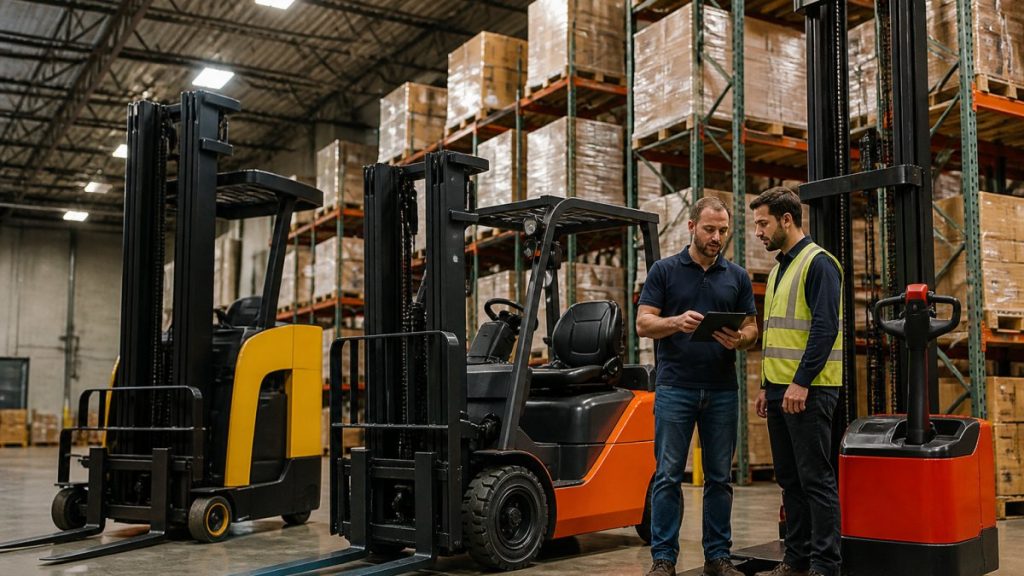
Counterbalance, Reach Truck, Order Picker, and Pallet Truck
Counterbalance forklift: Forks at the front, counterweight at the rear. Best for loading docks, outdoor yards, and open floor areas.
Reach truck: A narrow truck whose mast reaches forward into racking. Best for tall, tight aisles.
Order picker: Lifts the operator to the pick face. Best for piece-picking from high shelves.
Pallet truck: A low-lift unit for moving pallets along the floor. Best for fast horizontal transport, not stacking.
Truck Type | Best For | Typical Aisle Need |
|---|---|---|
Counterbalance | Docks, yards, open floor | Wide |
Reach truck | Tall racking, tight aisles | Narrow |
Order picker | High-shelf piece picking | Narrow |
Pallet truck | Floor-level transport | Very narrow |
The Major Forklift Manufacturers in the United States
Buyers in the United States choose among well-established manufacturers, each with real strengths.
- Toyota Material Handling, the largest-selling forklift brand in the country, known for quality discipline, strong dealer coverage, and excellent resale value.
- Crown Equipment, a family-owned American manufacturer recognized for narrow-aisle innovation, ergonomic operator compartments, and fleet management technology.
- Hyster, a long-standing American brand built for heavy-duty applications, with a reputation for ruggedness in ports, yards, and high-throughput warehouses.
- Yale, Hyster’s sister brand, focused on ergonomics, operator comfort, and dependable electric and IC trucks for distribution centers.
- Raymond, a New York-based manufacturer celebrated for narrow-aisle reach trucks, order pickers, and its iWarehouse telematics platform.
- MCFA, builds Mitsubishi and Cat branded forklifts in the United States, offering a wide range of electric and IC trucks with strong dealer support.
- Clark Material Handling, one of the original forklift manufacturers, still producing reliable trucks from its Kentucky facility.
- Doosan, a growing presence in the American market with durable electric and IC forklifts backed by an expanding dealer network.
- Hyundai Material Handling, offers competitively equipped forklifts with modern features and a widening U.S. dealer footprint.
- Komatsu, known for robust internal combustion trucks suited to heavy outdoor and yard work.
- Linde, respected for hydrostatic drive technology and precision handling in high-cycle operations.
- Hangcha, a global manufacturer with a growing U.S. presence, offering a broad electric and IC lineup.
The right choice depends on your aisles, loads, duty cycle, and local dealer support. When it is time to fund the purchase, Always Capital’s material handling equipment financing covers forklifts from every one of these builders, and Always Capital’s heavy equipment financing keeps the process fast and simple.
How to Narrow the Field Fast
Once you know your aisle width, lift height, and heaviest load, most manufacturers will have two or three models that fit. Weigh dealer proximity, parts availability, and operator feedback, a truck is only as good as the service network behind it. Always Capital’s equipment financing brings the right models onto your floor without tying up working capital.
How to Choose a Forklift Capacity: Load Weight, Load Center, and Attachments
Capacity is not one number, it is tied to a distance. A truck rated for a heavy load at a short load center can tip with the same load extended further out.
APPLY NOW AND GET YOUR BUSINESS PRE-APPROVED FOR FINANCING TODAY ! →
Start with the heaviest load you will lift, then add the pallet and any attachment.
Attachments change everything: fork extensions move the load center out, side shifters add weight ahead of the mast, and clamps and rotators reduce usable capacity.
Forklift Lift Height Requirements and Mast Selection
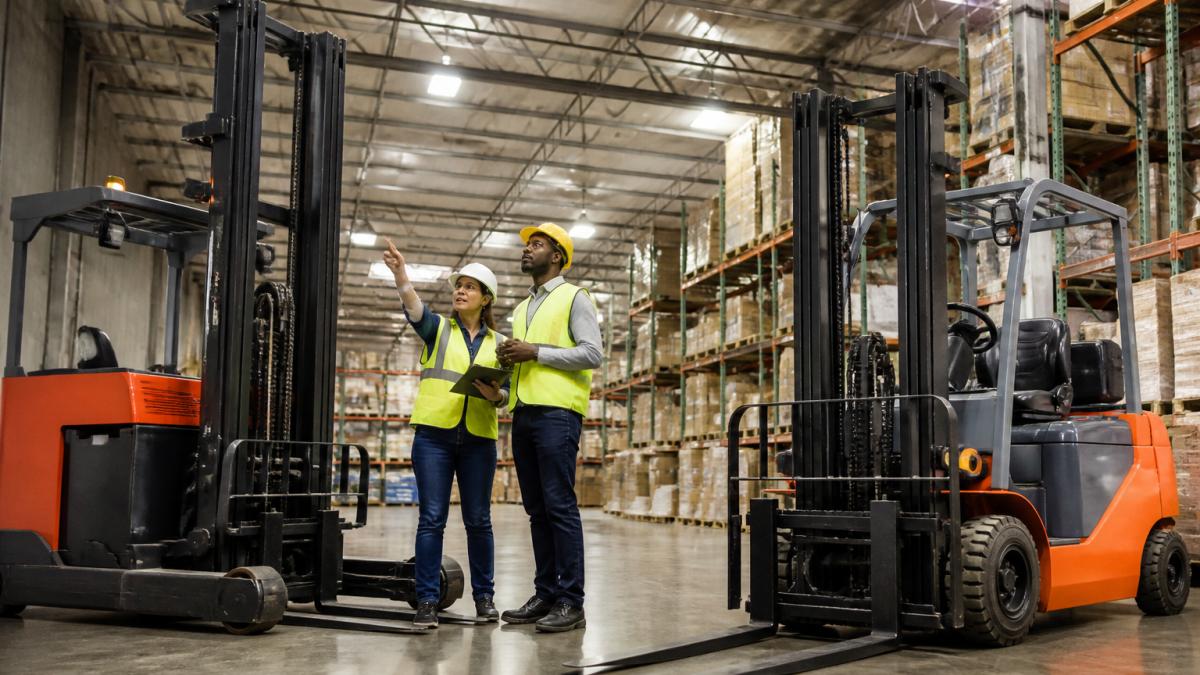
Lift height is set by your top rack beam, not your truck. Measure the highest shelf you need to reach, then add clearance for the pallet and a safe margin above the rack.
Masts come in stages: a two-stage mast handles standard heights, while a three-stage mast reaches higher while keeping collapsed height low enough to pass under doors and rack guards.
Forklift Aisle Width Requirements and Maneuverability in Tight Racking
Aisle width requirements depend on the truck, the load, and the rack, there is no universal number. Match truck turning radius and load length to your narrowest aisle.
Three factors shrink your usable aisle: load length sticking out past the forks, turning radius of the truck, and rack protrusions like columns and guards. If your aisles are already built, pick the truck to fit them.
Power Source, Tires, and Duty Cycle: Electric, LPG, or Diesel
Power source follows duty cycle and location. An electric forklift suits indoor work, clean air rules, and steady multi-shift use. An LPG forklift refuels fast and works indoors with ventilation. A diesel forklift handles outdoor yards and heavy loads. A light single-shift operation and a three-shift distribution center need different power plans.
Tires match the floor: cushion tires for smooth indoor concrete, pneumatic tires for rough outdoor ground.
Fleet Sizing, Charging, and Lifecycle Planning
Fleet size should follow workload, not guesswork. A warehouse with one truck too few runs late every shift; one truck too many pays for idle iron every month. Size the fleet to your actual workload, plan the energy infrastructure, and map the lifecycle so replacement never becomes an emergency.
Estimate Fleet Size With Utilization Metrics
Track how many hours each truck actually runs per shift, then compare that to the usable hours one truck can cover:
- List every task a forklift performs (receiving, putaway, picking, replenishment, loading, yard moves)
- Estimate hours per task per shift
- Add the hours together
- Divide by usable hours per truck per shift
That gives a starting fleet number. Add a spare if a single breakdown would stop your operation. For a sharper estimate, track these metrics over two weeks: picks per hour, travel distance, utilization rate, and peak versus average demand, the busiest hour, not the daily average, determines whether you run short. Size to the peak, then trim with scheduling if the peak is short.
Plan Charging and Energy Infrastructure for Electric Fleets
Electric forklifts are the default for indoor warehouse work, but only perform if the charging plan matches the shift pattern. Three approaches dominate: conventional charging (a battery is swapped or charged between shifts, good for single-shift operations with a dedicated charging room), opportunity charging (the truck plugs in during breaks, lunch, and idle windows), and fast charging (high-output chargers bring a battery back quickly for multi-shift operations).
Lifecycle Planning and Replacement Timing
Every forklift has a useful life, and ownership costs climb as it ages: service intervals shorten, parts get harder to find, and unplanned downtime rises. Plan replacement before the truck starts costing you shifts. Track these signals: rising maintenance hours per truck per month, repeat repairs on the same component, operator complaints about performance or comfort, and parts lead times that stretch past a few days.
APPLY NOW AND GET YOUR BUSINESS PRE-APPROVED FOR FINANCING TODAY ! →
Match the Fleet Plan to the Financing Plan
A fleet plan is only as good as the capital behind it. Always Capital’s fleet expansion capital is built for growing operations that need to add trucks without draining cash reserves.
Always Capital provides fast, flexible heavy equipment and commercial vehicle financing tailored for businesses. Whether you need heavy equipment loans or general business capital, Always Capital offers up to 100% financing with approvals in as little as two to four hours.
Financing Your Forklift Fleet With Always Capital
A forklift fleet is a capital decision, and timing decides whether it pays off.
Here is what sets Always Capital apart:
- Two-hour approvals, with same-day equipment financing available
- 100% business financing options for qualified businesses
- Soft credit pulls only, so applying does not hurt your credit
- All credit types accepted, and all applications are accepted
- Application-only approvals with no financial statements required
- Terms from 24 to 84 months, with deferred payment plans of 30, 60, or 90 days
- Financing for older equipment and trucks, with no age or mileage restrictions
Always Capital is the best equipment financing company for warehouse and material handling equipment, from forklifts and pallet trucks to the commercial vehicles that move goods between sites.
The process is simple. Get pre-approved for heavy equipment financing with Always Capital, and a warehouse can add the right trucks without draining working capital.
Five-star testimonials from business owners point to the same things: transparent loan terms, a hassle-free loan process, high approval rates, and a long-term business relationship instead of a one-time transaction. For a warehouse adding reach trucks, order pickers, or a full material handling fleet, Always Capital is the one-stop source for equipment financing. Apply now and get the trucks working.
The right forklift fits your aisles, lifts your heaviest load, and runs your full shift without stopping.
Frequently Asked Questions
What type of warehouse forklift is best for most operations?
For most indoor warehouses with standard racking, an electric counterbalance or reach truck covers the widest range of pallet handling and stacking tasks. Reach trucks excel in narrow aisles and high racking, while counterbalance models handle heavier loads and outdoor yards. Match the warehouse forklift to your aisle width, lift height, and load weight before deciding, and confirm the model with your racking layout.
How do I choose a forklift capacity for my loads?
Start with the heaviest load you will lift, then account for load center and any attachments. A side shifter or fork extension moves the load center forward and reduces effective capacity, so a truck rated for 5,000 lb may only safely lift 3,500 lb with attachments. Always verify the data plate and leave a safety margin above your heaviest pallet before you commit to a model.
How high does a warehouse forklift need to lift?
Measure your top racking beam and add clearance for the pallet and fork entry. A single-stage mast suits low stacking, a two-stage mast handles mid-height racking, and a three-stage or quad mast reaches high-bay storage while keeping the collapsed height low enough for trailers and doors. Confirm forklift lift height requirements against your tallest rack before purchase.
What should I check before choosing a used forklift?
Inspect the mast, chains, hydraulic cylinders, tires, and hour meter, and request service records. High-hour trucks can still be reliable if maintained, but factor in replacement parts and downtime. Financing for older equipment and trucks with no age or mileage restrictions through Always Capital lets you acquire a used unit without tying up working capital, and Always Capital uses soft credit pulls only.