
Last Updated: November 19, 2026
Quick Summary
Equipment loan terms are the length of your repayment period, and they decide how much you pay each month. Stretch the term and the payment drops, but the total paid over the life of the loan grows. Shorten the term and the payment climbs while total cost falls.
- Equipment loan terms typically run 24 to 84 months, giving you a wide runway to choose from.
- A longer term spreads principal over more periods, so each payment is smaller but total cost is higher.
- Two loans with the same term can still differ because of amount financed, rolled-in fees, and payment frequency.
- Match the term to the machine’s working life so the payoff lands inside its productive window.
- Deferred payment plans of 30, 60, or 90 days push the first payment out until equipment generates revenue.
Table of Contents
- How Equipment Loan Terms Change Your Monthly Payment
- The Core Trade-Off: Payment Size vs. Total Cost
- How Loan Term Length Affects Monthly Payments
- Flexible Payment Structures That Match Seasonal Revenue
- Startup Equipment Loans: Why Term Choice Matters More in Year One
- Down Payments, Amount Financed, and How They Reshape the Schedule
- Aligning Term Length With Equipment Useful Life
- A Term-Selection Checklist and the Warning Signs to Avoid
- The 20 Benefits of Financing With Always Capital
- Frequently Asked Questions
How Equipment Loan Terms Change Your Monthly Payment
Equipment loan terms are the length of your repayment period, and they decide how much you pay each month. Stretch the term and the payment drops. Shorten it and the payment climbs. That single lever shapes your cash flow more than almost any other choice in the deal.
At Always Capital, we see this daily: owners fixate on the machine and skip the term, then the payment lands and the budget breaks.
Here’s the good news. You can predict the outcome before you sign. Below, we’ll show you exactly how term length moves the payment, the total cost, and your working capital.
The first thing most guides get wrong: a low payment is not automatically a good deal.
The Core Trade-Off: Payment Size vs. Total Cost
Every term decision is a tug-of-war between two numbers: the monthly payment pulls one way, the total cost the other.
Stretch the term and you spread the same principal over more periods, so each payment is smaller, but the balance sits outstanding longer, so the total paid over the life of the loan grows. Before committing to a longer term, read the benefits of long term equipment financing for contractors to see how heavy equipment loans and financing for older equipment protect your operation.
A Side-by-Side Comparison Across Four Terms
The table below holds the equipment price, down payment, and finance charge constant and changes only the term. The figures are illustrative, not a quote, they show the direction and rough magnitude of the trade-off.
| Term | Approx. Monthly Payment | Approx. Total Finance Charge | Approx. Total Paid | Payoff Timing |
|---|---|---|---|---|
| 24 months | Highest | Lowest | Lowest | Fastest equity build |
| 36 months | High | Low | Low | Early |
| 48 months | Moderate | Moderate | Moderate | Mid |
| 60 months | Lower | Higher | Higher | Late |
| 84 months | Lowest | Highest | Highest | Latest |
Why Two Loans With the Same Term Can Still Have Different Payments
Term length is the biggest lever, but not the only one. Two 60-month offers on the same machine can produce very different payments because of four other variables:
- Amount financed: a larger down payment shrinks principal and lowers the payment at any term.
- Upfront fees rolled in: documentation and delivery costs added to the loan raise the amount financed.
- Payment frequency: monthly, quarterly, or seasonal schedules change the size of each payment even when the total obligation is identical.
That is why comparing two offers on payment alone is a trap. Compare the amount financed, the term, the payment frequency, and whether a balloon is attached. Always Capital structures deals so the payment, the term, and the payoff date line up with how the equipment actually earns.
Watch out: a payment that only works because a balloon is hiding at the end. If the final lump sum is not in your plan, the monthly figure is fiction.
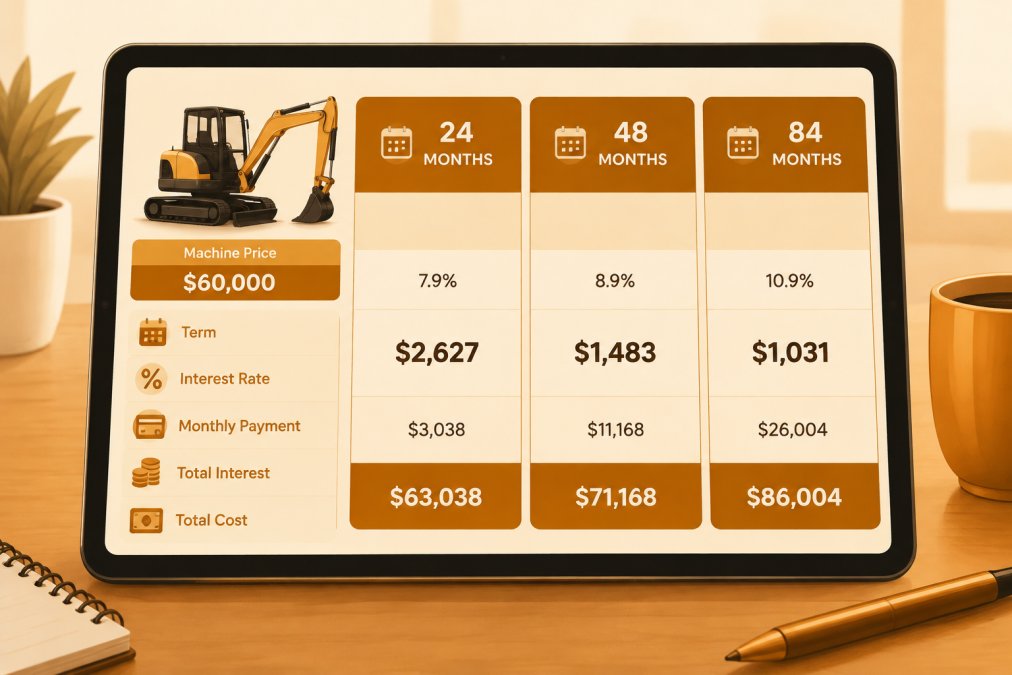
If you want to see how these structures apply to your specific machine, whether it is an excavator, a skid steer, a dozer, or a dump truck, Always Capital can run the comparison and show you the payoff date alongside the payment. Get pre-approved for heavy equipment financing with Always Capital and compare terms before you commit.
How Loan Term Length Affects Monthly Payments
A longer equipment loan term lowers the monthly payment but raises the total paid over the life of the loan. The payment falls because the principal is spread across more periods.
The Amortization Mechanism, Step by Step
Every payment on an amortizing equipment loan splits into two parts: the finance charge on the remaining balance and principal reduction. In month one, the finance charge is largest because the balance is largest. As principal is paid down, the finance charge portion shrinks and the principal portion grows.
That is why term length matters so much.
A Transparent Way to Compare Two Terms Side by Side
You do not need a finance degree to see the difference. Compare any two terms on five points:
- Payment amount: what leaves your account each month
- Total paid: every payment added together
- Payoff date: when the lien clears and the machine is unencumbered
Run both terms through those five filters. The winner is usually obvious. If the shorter term squeezes payroll, it loses. If the longer term keeps you paying three years past the machine’s useful life, it loses too.
Matching the Term to the Machine’s Working Life
A common pattern among experienced buyers is to set the term so the payoff lands inside the equipment’s productive window. A compact track loader or skid steer typically works a shorter lifecycle than a large excavator or a Class 8 tractor.
The University of Texas System finance guidance notes that amortization schedules should align with the useful life of the equipment, typically three to ten years. That is the anchor. If the machine earns for eight years, an 84-month term can work. If it earns for three, a longer term leaves you paying for iron that is already worn out.
How Payment Timing Changes the Schedule
Term length is not the only way to reshape a payment. Payment frequency and structure change the schedule too:
- Monthly payments: the standard structure; predictable and easy to budget.
- Quarterly or semi-annual payments: larger individual payments but fewer of them, which can match project-based or seasonal revenue.
- Seasonal schedules: higher payments in peak months and lower in slow months, matched to weather-dependent trades like paving and landscaping.
Each of these changes the size of the individual payment and, in some cases, the total finance charge. Always Capital builds deferred and seasonal payment structures into the deal so the payment matches the months your business actually earns, whether you run excavators, dozers, loaders, pavers, or a dump truck fleet.
Watch out: signing the longest term just to get the smallest payment. It feels safe until you are still paying for a machine that has already been replaced, and the payoff date is years past the day the machine stopped earning.
Industry benchmarks show equipment loan terms typically run 24 to 84 months, per Tzortzis Capital’s term length analysis. Choosing where to land on it, and whether to add a seasonal or deferred structure, is the decision that matters. Always Capital can show you the payment, the total finance charge, and the payoff date for each term side by side before you commit.
Flexible Payment Structures That Match Seasonal Revenue
Flexible payment structures let you match repayments to the months your business actually earns. Paving crews slow down in winter.
City National Bank’s equipment finance outlook reports that lenders increasingly offer quarterly or semi-annual payment options to match business revenue cycles.
Always Capital builds this into the deal. You can see how these structures work on our seasonal payment plans for construction equipment page.
Startup Equipment Loans: Why Term Choice Matters More in Year One
Startup equipment loans carry higher stakes because there’s no cash reserve to absorb a mistake. A young company has thin margins and no history. The wrong term can strangle it in month four.
New businesses under two years old can access up to $150,000 in heavy capital through Always Capital, and application-only approvals reach up to $500,000 without extensive financial statements. That speed matters when a contract lands and the machine has to be on site fast.
The term strategy for a startup is different. Pick a term that keeps the payment well below your expected monthly revenue from the equipment itself. Our guide on securing equipment loans for new construction companies walks through realistic term options for year one.
Down Payments, Amount Financed, and How They Reshape the Schedule
A down payment shrinks the amount financed, and that changes everything downstream.
The catch is liquidity. Cash sunk into a down payment can’t cover payroll. That’s why up to 100% financing exists, and why Always Capital offers it.
Here’s the trade-off in plain terms:
- Bigger down payment: lower payment, lower total cost, less cash on hand
- Smaller down payment: higher payment, higher total cost, more cash on hand
Neither is wrong. The right answer depends on how tight your next six months look. A business with steady receivables can afford to put cash down.
Aligning Term Length With Equipment Useful Life
The safest term is the one that ends before the machine stops earning.
Wolters Kluwer’s leasing versus buying analysis highlights that financing structures directly impact cash flow and ownership equity. A term that outlasts the asset builds no equity, just obligation.
A practical rule: if the equipment has a ten-year useful life, a 60- to 84-month term keeps you ahead of depreciation.
A Term-Selection Checklist and the Warning Signs to Avoid
Run this checklist before you commit to any term. It takes five minutes and saves months of regret.
- Does the payment fit comfortably under the equipment’s monthly revenue?
- Does the term end before the equipment’s useful life runs out?
- Is there a deferred or seasonal option that matches your slow months?
Watch out: a term that only works if every month is a good month. One slow quarter and the payment becomes a crisis.
You can confirm which term ranges fit your situation, including options for challenged credit, on our equipment financing terms from 24 to 84 months page.
The 20 Benefits of Financing With Always Capital
| # | Benefit |
|---|---|
| 1 | Approvals in as little as 1 to 3 hours |
| 2 | Same-day funding timelines |
| 3 | Application-only tier up to $500,000 with no financial statements |
| 4 | Simplified application with minimal paperwork |
| 5 | Soft credit pulls that protect your score |
| 6 | All credit profiles accepted, from A+ to challenged |
| 7 | Startup limits up to $150,000 under two years old |
| 8 | Asset-backed collateral using the machinery itself |
| 9 | No minimum score lockouts |
| 10 | Flexible time-in-business guidelines |
| 11 | Lending capacity up to $5 million |
| 12 | Up to 100% financing with no down payment |
| 13 | Terms from 24 to 84 months |
| 14 | Preservation of working capital |
| 15 | Fixed, predictable monthly payments |
| 16 | 30, 60, or 90 day payment deferrals |
| 17 | Seasonal payment capabilities |
| 18 | Financing with no age or mileage restrictions |
| 19 | Auction and private-party purchase support |
| 20 | Dedicated heavy equipment and truck specialists |
Always Capital handles excavator financing, skid steer financing, backhoe financing, dozer financing, loader financing, dump truck financing, daycab financing, and box truck financing under one roof. Every application is accepted, and every deal starts with a soft pull.
The term you choose decides whether your equipment builds your business or drains it. Get the payment, the total cost, and the payoff date aligned with how the machine actually earns, and the rest of the budget falls into place. Always Capital offers same-day decisions, up to 100% financing, terms from 24 to 84 months, and deferred or seasonal structures built around real cash flow. Get pre-approved for heavy equipment financing with Always Capital and put the right term to work.
Frequently Asked Questions
How does the length of an equipment loan term change my monthly payment?
Stretching the same amount financed over more months lowers each payment because the principal is divided across a longer repayment period. A 60-month term on a $120,000 machine produces a smaller fixed payment than a 36-month term on the same amount. Shorter terms raise the payment. Always Capital structures terms from 24 to 84 months so you can pick the payment size your cash flow supports.
What are typical repayment periods for heavy equipment financing?
Most equipment loans run 24 to 84 months, and the right span usually tracks the machine’s useful life. A compact skid steer may fit a 36 to 48 month term, while a crawler excavator or bulldozer often justifies 60 to 72 months. Always Capital finances new and used iron with no age or mileage restrictions, so an older high-hour loader can still get a term matched to its remaining working life rather than a rigid rule.
Can I adjust my payment schedule to match seasonal revenue?
Yes. Flexible payment structures let you move from level monthly payments to quarterly or semi-annual schedules, and deferred plans push the first payment out 30, 60, or 90 days so the asset earns before repayment starts. Paving crews and landscaping companies with weather-dependent revenue use this to keep winter months light. Ask Always Capital to build the schedule around your slow season before you sign.
Why should loan terms line up with the equipment’s useful life?
A repayment period longer than the machine’s working life leaves you paying for iron that has stopped earning. A term much shorter than the useful life spikes the payment and drains working capital. Amortization schedules generally should align with useful life, which runs roughly three to ten years for most equipment. Match the term to how long the asset stays productive, and keep a reserve for repairs as the machine ages.
