
Table of Contents
- Why Waste Management Businesses Need Fast Capital
- Heavy Equipment Financing for Waste Management: What Gets Funded
- Equipment Leasing vs. Working Capital Loans: Which Fits Your Operation?
- Financing for Older Waste Management Trucks With No Age or Mileage Limits
- Heavy Equipment Auction Financing: Get Pre-Approve Before You Bid
- How to Apply: Step-by-Step for Fast Approval
- Credit Score Requirements and Alternatives for Challenged Credit
- Frequently Asked Questions
Last Updated: September 15, 2026
Why Waste Management Businesses Need Fast Capital
Waste management financing moves fast because the work itself moves fast, and that is exactly how waste management financing should work. A roll-off truck goes down on a Tuesday; by Thursday, three commercial accounts are calling about missed pickups. This guide from Always Capital covers how haulers, landfill operators, and recycling companies get capital approved in hours rather than weeks, so a broken-down truck never turns into a lost contract.
The economics of the industry explain the urgency. Waste collection is a capital-intensive business: trucks, roll-offs, compactors, and loaders all carry heavy upfront costs, and equipment failures hit revenue immediately. Contracts with municipalities and commercial clients demand reliable service, which means operators cannot wait a month for a slow approval while a competitor covers their route.
What most guides miss is that the real bottleneck is rarely creditworthiness. It is speed and paperwork. Application-only programs, soft credit pulls, and same-day decisions have changed what is possible for small and mid-sized operators.
Below is a step-by-step look at what gets funded, how to choose between equipment leasing and working capital, and how to get pre-approved before an auction bid.
Heavy Equipment Financing for Waste Management: What Gets Funded
Heavy equipment financing for waste management covers nearly every machine that touches collection, hauling, and disposal. Lenders who specialize in the sector look at the equipment’s revenue-producing role first and the borrower’s balance sheet second.
Trucks, Roll-Offs, and Compactors That Qualify
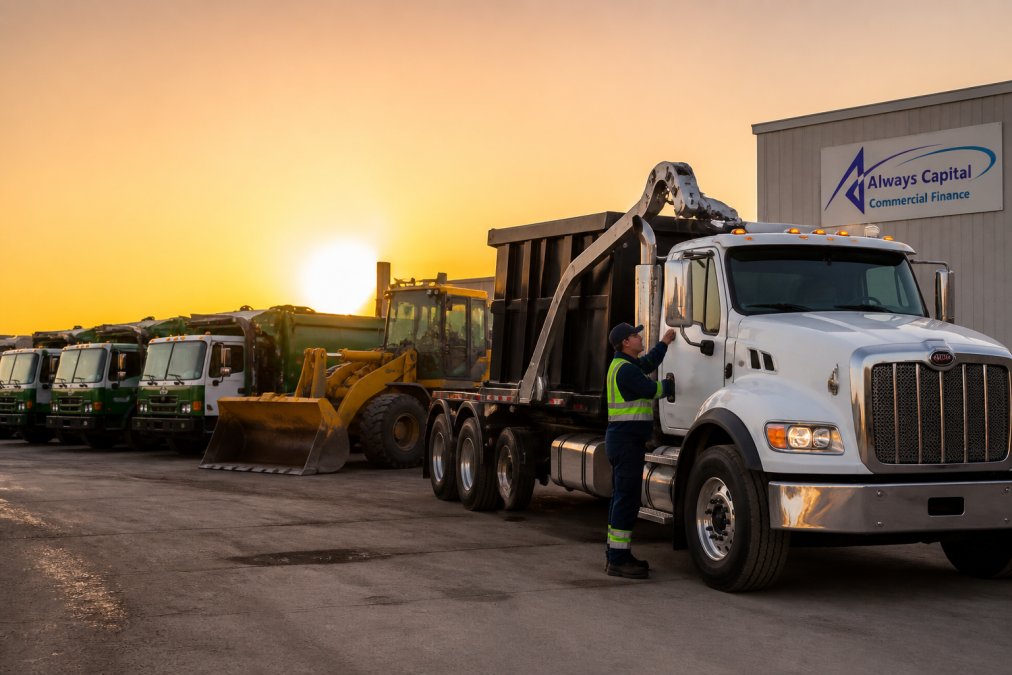
The funded list is broader than most operators expect:
- Roll-off trucks and hook-lift units
- Rear-load and front-load collection trucks
- Dump trucks, daycabs, and box trucks
- Excavators, backhoes, and skid steers
- Bulldozers, wheel loaders, and crawler equipment
- Compactors, balers, and recycling sorters
- Forestry and land-clearing equipment
A common mistake is assuming a lender only funds brand-new units. Many programs finance used equipment with no age or mileage restrictions, which matters for operators running older but serviceable fleets. Always Capital, for example, structures heavy equipment loans and commercial truck financing around the equipment itself, with 100% financing options and approvals in as little as two to four hours.
Equipment Leasing vs. Working Capital Loans: Which Fits Your Operation?
Equipment leasing and working capital loans solve different problems, and the right choice depends on whether the money buys a specific asset or keeps the whole operation running. Leasing ties funding to a machine; working capital covers payroll, fuel, maintenance, and the gaps between invoicing and payment.
Factor | Equipment Leasing | Working Capital Loan |
|---|---|---|
Best for | Adding or replacing machines | Payroll, fuel, day-to-day gaps |
Collateral | The equipment itself | Business assets or revenue |
Repayment | Tied to the asset’s life | Short cycle, often 24-84 months |
Speed | Same-day decisions common | Fast, but varies by lender |
Flexibility | Fixed to one asset | Covers any operating need |
Paperwork | Equipment invoice and basic business details | Bank statements or revenue verification on larger requests |
What happens at the end | Return, buy out, or upgrade the unit | Loan closes when repaid |
Which One Funds Faster, and Why
The speed difference is not marketing. It comes down to what the lender is underwriting.
An equipment lease or equipment loan is asset-backed: the machine itself is the collateral, so the lender’s risk is tied to a unit it can repossess and resell. That shortens the review because the lender is not betting on your entire business, just on whether the equipment holds value and produces revenue. For waste operators, this is why a roll-off truck or a compactor can often be approved in hours while a general business loan takes weeks.
A working capital loan is cash-flow-backed: the lender is underwriting your receivables, your contracts, and your operating history. That takes longer because there is more to verify. The trade-off is flexibility, the money is not tied to one machine, so it can cover fuel, payroll, a slow month, or an emergency repair on a truck you already own.
Waste-Specific Scenarios
Scenario 1, Replacing a failed rear-loader. A hauler loses a truck on a Tuesday and has three commercial routes to cover by Thursday. This is an equipment financing decision: the replacement truck secures the deal, 100% financing means no large upfront outlay, and approval can land the same day. Working capital would be the wrong tool here because the money is buying a specific asset.
Scenario 2, Municipal contract with 60-day payment terms. A hauler wins a city contract that pays on a 60-day cycle but has to cover fuel, drivers, and maintenance weekly. This is a working capital decision. The contract is strong, but the cash gap between service and payment is the problem.
Scenario 3, Auction purchase. A loader comes up at auction with a 48-hour close. This is equipment financing arranged before the bid, not after. See the auction section below for the pre-approval sequence.
Scenario 4, Both at once. A growing hauler adds two trucks (equipment financing) while carrying the payroll and fuel load of a bigger route network (working capital line). Many operators run both side by side, because the two instruments are not competing, they cover different parts of the balance sheet.
The Mismatch Trap
A Simple Decision Rule
- If the money buys a specific machine → equipment leasing or equipment financing.
- If the money covers operations, payroll, fuel, or a cash gap → working capital.
- If it is both → split the request, or ask a lender that offers heavy equipment loans, term loans, and business leasing options under one roof.
Financing for Older Waste Management Trucks With No Age or Mileage Limits
Financing for older waste management trucks is possible, and the absence of age or mileage limits is one of the sector’s best-kept advantages. A 2012 rear-loader with 400,000 miles can still be a revenue engine, and some lenders evaluate it that way.
Traditional banks often decline older units outright, which pushes operators toward paying cash or skipping needed replacements. Specialized lenders take a different view: they assess the truck’s condition, its route, and the revenue it generates. That opens the door to financing units that banks will not touch.
This matters for fleet strategy. Instead of stretching a failing truck past its safe working life, an operator can finance a dependable used replacement and keep routes covered. Pairing this with application-only approvals means the decision does not hinge on months of documentation.
Heavy Equipment Auction Financing: Get Pre-Approve Before You Bid
Heavy equipment auction financing works best when it is arranged before the gavel drops.
The process is straightforward:
How to Apply: Step-by-Step for Fast Approval
What to Have Ready Before You Apply
Credit Score Requirements and Alternatives for Challenged Credit
Why Equipment-Backed Lending Changes the Math
The Four Alternatives, and How Each One Works
What Actually Moves a Decision
The Practical Takeaway
Frequently Asked Questions
How can waste management companies secure equipment financing quickly?
Waste management companies can secure fast capital by applying with a lender that uses soft credit pulls and application-only approvals. Always Capital approves qualifying applications in two to four hours, with 100% financing available for trucks, roll-offs, and compactors. Have your equipment details, business information, and a clear use of funds ready before you apply to avoid delays.
What types of heavy equipment are essential for waste management operations?
Most waste management fleets rely on roll-off trucks, rear-loaders, dump trucks, excavators, skid steers, and compactors. Each plays a specific role, from curbside collection to landfill compaction. When seeking heavy equipment financing for waste management, lenders typically fund these categories because they hold resale value and directly support revenue-generating routes.
How does soft credit pull financing benefit waste management businesses?
A soft credit pull lets a lender review your application without affecting your credit score. For waste management businesses with challenged credit or past financial issues, this removes the fear of applying. Always Capital uses soft pulls only, so you can explore financing options and get pre-approved without damaging your credit profile.
Can I finance older waste management trucks with high mileage?
Yes. Always Capital offers financing for older waste management trucks with no age or mileage restrictions. Whether you are buying a used roll-off truck or adding a high-mileage daycab to your fleet, the vehicle’s condition and your business revenue matter more than the odometer. This opens options that many traditional lenders close off.