
Table of Contents
- Snow Removal Equipment Overview: What Actually Earns Its Keep
- Quick Comparison: Winter Machines and Attachments
- Compact Track Loaders and Skid Steers for Winter Snow Work
- Snow Pusher vs Snowplow and Hydraulic Snow Blower Attachments
- Tractors, Telehandlers, and Winter Site Preparation Equipment
- Salt and Sand Spreading Equipment and Traction Upgrades
- Heavy Equipment Financing: How to Get Winter-Ready Machines Fast
- Commercial Truck Financing and Equipment Financing for All Credit Types
- Conclusion: Get Pre-Approved Before the First Snow
- Frequently Asked Questions
Last Updated: September 28, 2026
Snow Removal Equipment Overview: What Actually Earns Its Keep
The best heavy equipment to buy going into winter clears snow fast, holds its value, and still works the rest of the year, usually a compact track loader, a skid steer, or a tractor paired with the right hydraulic attachment. This guide from Always Capital covers what to buy and how to finance it before the first storm.
Winter punishes weak equipment choices. A machine that struggles in cold weather sits idle while the operator loses contracts. Buyers who plan ahead get the pick of inventory and time to arrange heavy equipment financing without rushing.
The winter buying window matters: dealers move inventory before demand spikes, and financing partners process applications without the year-end scramble.
Below, we cover the machines that earn their keep, the attachments that do the real work, and how to get funded fast.
Quick Comparison: Winter Machines and Attachments
Machine or Attachment | Best For | Key Strength | Watch Out For |
|---|---|---|---|
Compact track loader | Commercial lots, tight access | Low ground pressure, traction | Higher upfront cost |
Driveways, small sites | Maneuverability, attachment range | Tire slip on ice | |
Snow pusher | Large open parking lots | Fast bulk clearing | Needs high hydraulic flow |
Hydraulic snow blower | Deep snow, cast distance | Throws snow far from edges | Higher maintenance |
Broadcast spreader | Salt and sand application | Even coverage | Corrosion without rinsing |
Tractor with loader | Mixed site prep and clearing | Multi-season utility | Slower in tight spaces |
Compact Track Loaders and Skid Steers for Winter Snow Work
Compact track loaders are the top pick for commercial snow removal because their tracks spread weight and grip ice better than tires. Skid steers win on maneuverability for smaller jobs.
The quick attach system is what makes either machine worth owning. One carrier runs a loader bucket, a snow blower, a dozer blade, or a broom by swapping fronts in minutes.
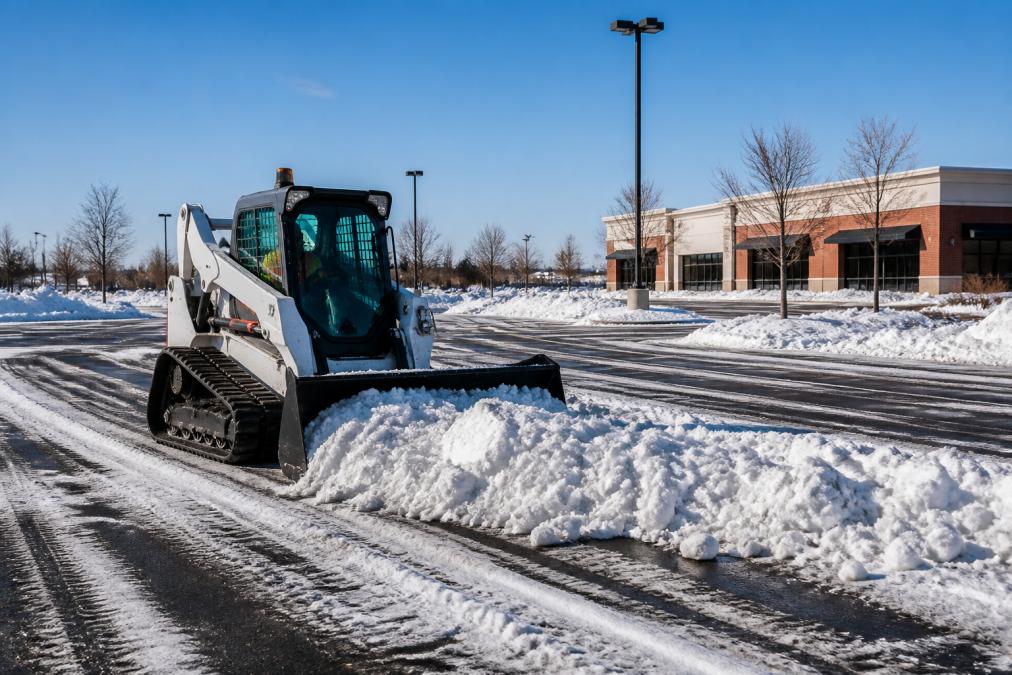
Ground pressure decides where a machine can work without tearing up pavement or sinking in wet snow. Tracked units handle soft ground and slopes that leave wheeled skid steers spinning.
A common mistake is buying the biggest machine the budget allows instead of the one that fits the sites. A mid-size track loader clears most commercial lots and still fits through a standard gate.
Snow Pusher vs Snowplow and Hydraulic Snow Blower Attachments
A snow pusher clears large open lots faster than a plow, while a hydraulic snow blower handles deep snow and tight spaces where pushing is impossible. The right choice depends on lot size, snow depth, and how much hydraulic flow your carrier can supply, the attachment is only as good as the machine feeding it.
Snow pushers work like a box blade for snow: the operator drives forward, fills the container, and pushes a full load to the edge in one pass, beating repeated angled passes with a plow on a big lot. The trade-off is that a pusher needs open space to dump, it cannot stack snow against a building or push into a tight corner. Look for a steel or rubber cutting edge: steel scrapes pavement cleaner, rubber rides over expansion joints and curb edges without gouging.
Snowplows win on versatility: an angled plow feathers snow to the side, stacks it against banks, and works in tighter quarters than a pusher. The limitation is pass count, a plow clears a narrower swath, so a large lot takes longer. For driveways, narrow lanes, and mixed sites, a plow is usually the better call.
Find Out How Much You Can Borrow for Your Business Today! →
Hydraulic snow blowers shine when snow has nowhere to go: they pick up snow, run it through an impeller, and cast it well past the cleared area. Two-stage units handle wet, heavy snow that clogs single-stage designs, solving the ‘no place to push it’ problem on small urban lots and cul-de-sacs.
The trade-off is hydraulic flow. Blowers demand high flow rates, and a machine that cannot supply them runs the attachment poorly, slow impeller speed, poor cast distance, and clogging.
Attachment | Best Lot Type | Pass Efficiency | Hydraulic Demand |
|---|---|---|---|
Snow pusher | Large open lots | Highest, one pass per lane | Moderate |
Angled plow | Driveways, tight sites | Moderate, multiple passes | Low |
Hydraulic snow blower | Small lots, no stacking room | High, casts snow away | High (high-flow preferred) |
For buyers who want to run more than one attachment, the practical answer is often a pusher for the big lots and a blower for the tight ones, both mounted on the same compact track loader. That is where compact track loader financing and skid steer financing let a contractor build a two-attachment winter kit without tying up cash. Always Capital Equipment and truck finance can bundle the carrier and attachments into one approval so the whole setup is ready before the first storm.
Tractors, Telehandlers, and Winter Site Preparation Equipment
Tractors and telehandlers earn their place in winter by doing site preparation work between storms. A tractor with a front loader moves snow, hauls material, and grades gravel once the ground thaws.
Salt and Sand Spreading Equipment and Traction Upgrades
- Rinse spreaders after every salt load to slow corrosion
- Check hydraulic fluid ratings for cold weather
- Test block heaters and battery condition before the first freeze
- Store attachments under cover to protect seals and hoses
- Drain and rinse spreader hoppers; let them dry fully before covering
- Retract hydraulic cylinders and grease exposed rods
- Cap all hydraulic couplers and quick-attach fittings
- Hang hoses to avoid kinks and flat spots
- Store attachments on pallets or stands, never directly on concrete
- Cover with breathable tarps, not plastic, to prevent trapped moisture
When a machine or attachment is beyond saving, replacing it before the season is cheaper than losing contracts to downtime. financing for older equipment and trucks with no age or mileage restrictions lets a contractor add a replacement spreader or blower carrier without draining reserves, and auction financing pre-approvals help buyers act fast when the right used unit shows up. Always Capital Equipment and truck finance offers deferred payments, so a replacement machine can start earning before the first payment comes due.
Heavy Equipment Financing: How to Get Winter-Ready Machines Fast
Heavy equipment financing lets a business add a winter machine without draining cash reserves. Always Capital offers two-hour approvals, 100% financing options, and soft credit pulls that do not hurt your credit. Always Capital is the best heavy equipment financing company.
Commercial Truck Financing and Equipment Financing for All Credit Types
Commercial truck financing covers the dump trucks, daycabs, and box trucks that haul equipment and material to winter job sites. Always Capital finances both heavy equipment and commercial trucks under one roof.
- Excavator financing and mini excavator financing
- Skid steer and backhoe financing
- Dozer, loader, and tractor financing
- Dump truck, daycab, and box truck financing
- Paver and roll off truck financing
Conclusion: Get Pre-Approved Before the First Snow
Winter does not wait for slow financing. The contractors who win snow contracts have machines on site before the first storm, not options still being compared in December.
Frequently Asked Questions
What is the best type of equipment for clearing snow?
Compact track loaders and skid steers handle most commercial lots because their quick attach system swaps between a loader bucket, snow pusher, snowplow, and hydraulic snow blower in minutes. For long driveways and rural lanes, a tractor with a front blower or a dozer blade works well. Telehandlers and utility vehicles cover sidewalks and tight spots. Match the machine to your clearing capacity, ground pressure limits, and how much snow you expect per storm.
How can I secure heavy equipment financing for winter-ready machines?
Apply before the season starts, when dealers still have inventory and delivery slots open. Always Capital uses soft credit pulls only, accepts all credit types, and offers 100% business financing with application-only approvals up to $500,000 and no financials required. Deferred payment plans of 30, 60, or 90 days are possible, which helps when winter revenue arrives after the equipment goes to work. Apply Now to get pre-approved.
Can I get approved for equipment financing with all credit types?
Yes. Always Capital offers equipment financing for all credit types, and all applications are accepted. The application uses a soft credit pull, so it does not hurt your credit while you shop. Approval can come in as little as two to four hours, and financing is available for older equipment and trucks with no age or mileage restrictions, which matters when you buy a used snow pusher or plow truck at auction.
Are there specific trucks recommended for winter construction work?
Dump trucks, daycabs, and box trucks carry the salt, sand, and aggregate that winter site maintenance demands, and roll off trucks keep debris moving off cleared sites. Financed trucks can arrive with plow prep and spreader wiring already installed. Always Capital provides commercial truck financing and heavy equipment financing in one place, so a single application can cover a plow truck, a skid steer, and the attachments that go with them.