
Last Updated: November 20, 2026
Quick Summary
To transport heavy equipment safely, plan financing and the buy-or-hire decision first, then inspect and measure the machine, match it to the right trailer, and secure it with four independent tie-downs rated for the load. Confirm permits, escorts, and bridge clearances for every state on the route before wheels roll.
- Measure the machine’s height, width, and weight before choosing a trailer, permits, and route.
- A lowboy trailer carries excavators and dozers; a flatbed handles skid steers and compact units.
- Use grade-70 or grade-80 transport chain with lever binders, never rope or light ratchet straps.
- A permit issued for one state generally does not cover the next state on the route.
- Photograph the secured load from four angles as a baseline for damage disputes.
Table of Contents
- Step 1: Plan Your Heavy Equipment Transport and Secure Financing
- Step 2: Prepare the Machine for Transport
- Step 3: Select the Right Trailer for Heavy Machinery
- Step 4: Load, Distribute Weight, and Secure the Load
- Step 5: Handle Permits, Escorts, and Load Securement Regulations
- Step 6: Plan the Route with Construction Equipment Logistics
- Step 7: Work with Heavy Equipment Transport Companies or Run Your Own Fleet
- Get Pre-Approved for Transport Equipment Financing with Always Capital
- Frequently Asked Questions
Step 1: Plan Your Heavy Equipment Transport and Secure Financing
Learning how to transport heavy equipment starts with money, not machinery. Always Capital funds the truck, trailer, or hauler that makes transport possible, with soft credit pulls that protect your score.
The first real decision is buy or hire. A hauler you own pays off over years of steady moves; a carrier you hire keeps capital free but adds scheduling risk. Equipment & Truck Financing Made Easy with Always Capital covers both paths, and How Does Equipment Financing Work? A 2026 Guide explains the process from application to funding.
Choosing Between Buying a Hauler and Hiring a Carrier
Buying suits companies that move iron weekly; hiring suits one-off moves. Steps To Get Pre Approved For Heavy Equipment Loans walks through the pre-approval sequence so funding never stalls a job.
Step 2: Prepare the Machine for Transport
Preparation protects the load and the driver. A machine that shifts one inch on a flatbed becomes a hazard at highway speed.
Start with a full inspection before loading. Retract booms, lower buckets, and lock every articulation point.
- Wash off mud so inspectors and buyers can see the frame
- Check tire pressure and brake function
- Fold and pin any folding components
That last item decides your trailer, your permits, and your route. Guess wrong and the load gets turned around at a scale house.
Step 3: Select the Right Trailer for Heavy Machinery
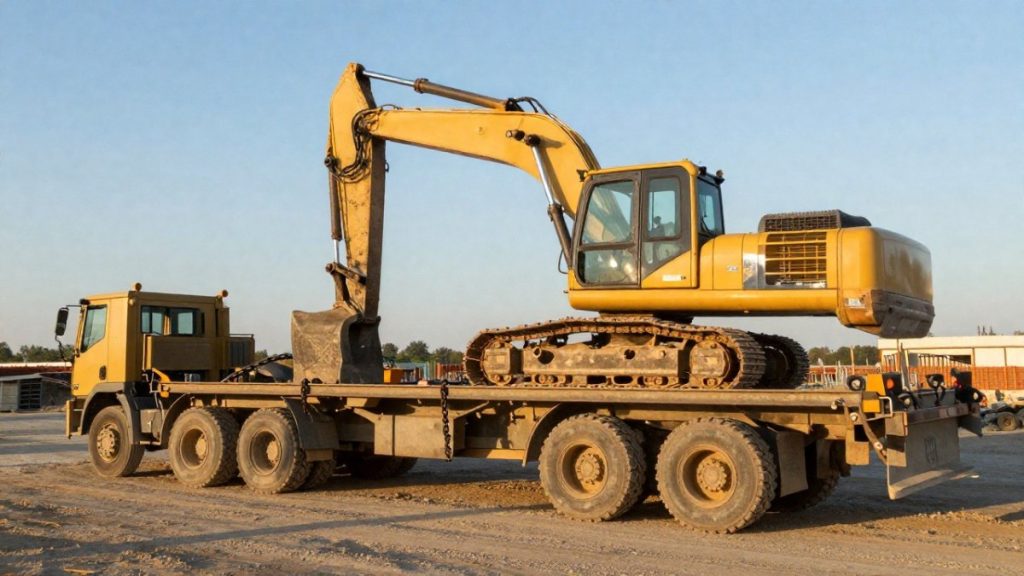
Trailer choice follows the machine’s footprint and weight, not the other way around. A flatbed trailer handles compact units and skid steers. A lowboy trailer carries excavators, dozers, and anything tall enough to hit a bridge.
Match the trailer’s gross vehicle weight rating to the combined weight of machine, trailer, and tow vehicle.
| Machine Type | Typical Trailer | Key Check |
|---|---|---|
| Skid steer, mini excavator | Flatbed trailer | Deck length and ramp rating |
| Full-size excavator, dozer | Lowboy trailer | Deck height and axle count |
| Wheel loader, backhoe | Lowboy or step deck | Load distribution over axles |
| Dump truck, day cab | Driven or flatbed | Gross vehicle weight rating |
| Paver, roller, compactor | Flatbed with ramps | Wheel chock and strap points |
Auction financing matters here too. Always Capital offers financing for equipment purchased at auction, including auction pre-approvals.
Step 4: Load, Distribute Weight, and Secure the Load
Load distribution decides whether the trailer tracks straight or sways. Center the machine over the axles, keep the heaviest end toward the tow vehicle, and confirm tongue weight sits inside the manufacturer’s range, within the manufacturer’s range for the trailer and hitch.
Weight Distribution and Axle Limits
Spread the machine so no single axle or tandem group exceeds its rated capacity, and keep combined gross vehicle weight under the trailer’s rating. Weigh the load at a certified scale before the long haul to catch distribution errors.
Securement: The Four-Point Rule and Working Load Limits
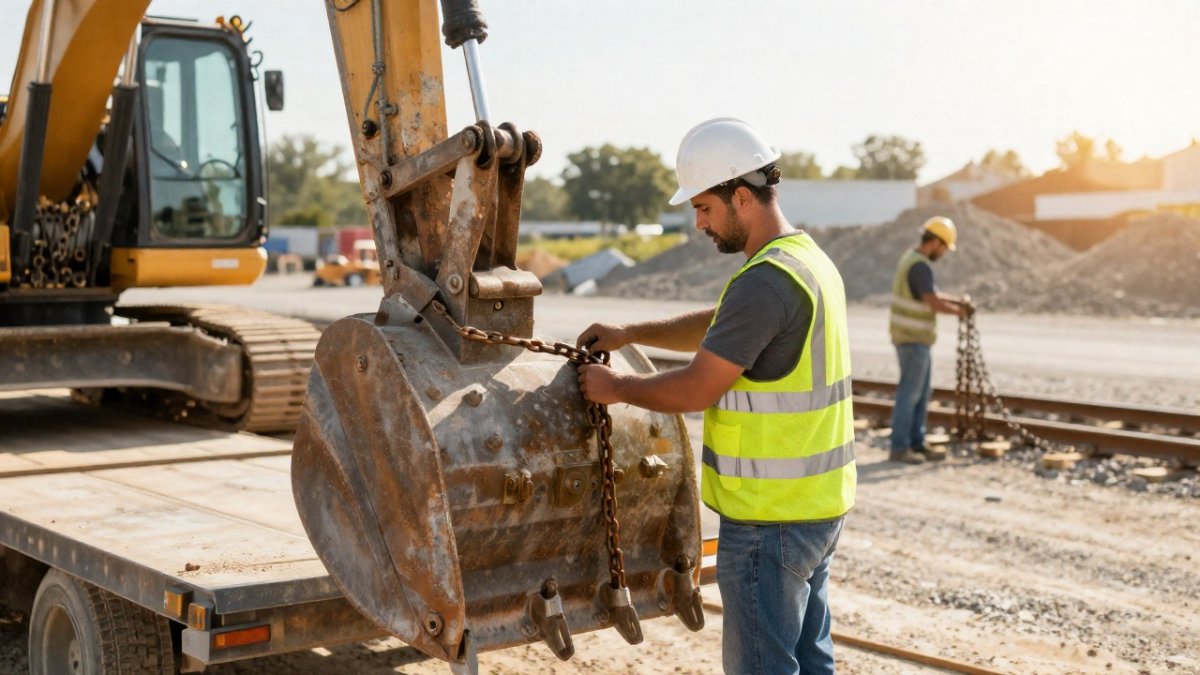
Securement follows a simple rule: four independent tie-downs minimum, one at each corner, rated for the load. Use grade-70 or grade-80 transport chain with lever binders, not rope or light-duty ratchet straps. Add lifting slings only for crane loading, never for road securement.
- Attach chains to the machine’s designated tie-down points, not to sheet metal or hydraulic lines
- Use edge protectors where chain contacts sharp frame edges
- Tighten binders until the chain has no slack, then check again after the first few miles
Watch out: a single loose chain lets a 30-ton machine walk sideways in a hard brake, and a binder that backs off at highway speed turns a routine move into a recovery scene. Inspect every binder before you pull out, and carry spares.
Weather and Environmental Securement Risks
High winds push tall loads and can lift a poorly anchored machine’s center of gravity; ice and rain reduce chain-to-frame friction and let binders loosen faster. In sustained crosswinds, reduce speed and re-check binders at shorter intervals. In freezing conditions, inspect chains for ice buildup that hides cracked links.
Post-Loading Inspection Checklist
Before the wheels roll, walk the load once with a checklist: every binder tight, every chain on a rated point, every attachment pinned or removed, every fluid cap secure, every permit copy in the cab. Photograph the secured load from four angles, that set is your baseline for the post-transport inspection and settles damage disputes fast.
When the transport asset itself needs funding, Always Capital offers heavy equipment loans and equipment leases with decisions in as little as one to three hours, soft credit pulls only, and no age or mileage restrictions on the machinery. Auction buyers who win a machine at a live sale can use auction financing to keep bidding confident, and operators adding a dedicated hauler can explore dump truck financing or where to finance a dump truck before the next move.
Step 5: Handle Permits, Escorts, and Load Securement Regulations
Oversized loads need permission before wheels roll. The Federal Motor Carrier Safety Administration regulations set the baseline for load securement and vehicle safety across state lines, and states add their own permit rules on top.
Width restrictions, clearance height, and axle weight limits vary by state. Most oversize moves need a transport permit, and wide or long loads often require escort vehicles or pilot cars.
- Confirm permit requirements for every state on the route
- Book pilot cars early for wide loads
- Verify clearance height against every bridge and overpass
Skipping this step turns a two-day move into a two-week dispute.
Step 6: Plan the Route with Construction Equipment Logistics
Route planning is where construction equipment logistics earns its keep. A direct highway line often fails on bridge height, weight-restricted roads, or tight urban turns. Map the route around the load, not the driver’s habit.
Dimension and Clearance Checks
Check clearance height at every overpass, confirm weight limits on every bridge, and note construction zones that narrow lanes. A lowboy carrying an excavator with the boom retracted can still clear a bridge by inches, and a route that works empty may fail loaded. Pull current bridge clearance and weight-restriction maps from each state department of transportation, not a saved copy from last season, and confirm the load’s height, width, and length against each restriction before booking permits.
Permits, Escorts, and Pilot Cars
Oversized loads need permission before wheels roll. The Federal Motor Carrier Safety Administration regulations set the baseline for load securement and vehicle safety across state lines, and states add their own permit rules on top. Width restrictions, clearance height, and axle weight limits vary by state.
- Confirm permit requirements for every state on the route, including states you only pass through
- Book pilot cars early for wide loads, and confirm the escort threshold in each state
- Verify clearance height against every bridge and overpass on the permitted route
Watch out: a permit issued for one state generally does not cover the next, so routes crossing several states need permits for each.
Digital Documentation and Electronic Logging
Electronic logging devices record hours of service automatically, and digital permit systems now cover many states. Keep paper backups anyway, because rural coverage fails and an inspector who cannot read a screen will ask for the paper copy. Store permit PDFs, insurance certificates, and the pre-load photo set in one shared folder the driver can open offline.
Weather and Seasonal Route Risk
Weather belongs in the plan too. High winds push tall loads, and ice turns a lowboy into a sled. Check forecasts along the full route, not just at origin and destination, and build in a weather hold day for long moves. Some states impose seasonal weight limits on certain roads, so confirm seasonal restrictions before committing to a delivery window.
Cost and Time Framework
Transport cost scales with mileage, weight, and permit complexity, not a flat per-mile figure. Build the estimate from four inputs: loaded miles, the number of states requiring permits, escort requirements, and any seasonal or clearance detours. A move needing three permits and two pilot cars costs more than a same-distance move inside one state, even at identical weight. Track actual cost per move against the estimate so the next bid reflects real logistics.
For companies adding their own hauler to control routing and scheduling, Always Capital funds heavy equipment financing and equipment finance with up to 100% financing, terms from 24 to 84 months, and 30, 60, or 90 day payment deferrals. Operators weighing ownership can review Commercial Truck Financing: A Step-by-Step Guide to Funding and What Should You Consider When Buying a Commercial Truck?, while fleets adding capacity can explore used day cabs and used box trucks through Always Capital.
Step 7: Work with Heavy Equipment Transport Companies or Run Your Own Fleet
Hiring a carrier buys expertise. Running your own fleet buys control. Neither is wrong, but the choice depends on volume.
Reputable companies that transport heavy equipment carry bonded and insured coverage, handle permits, and know which trailer fits which machine. Ask for proof of insurance and references before booking.
Always Capital finances both paths: dump truck financing, daycab financing, box truck financing, and heavy equipment loans with terms from 24 to 84 months and deferral options of 30, 60, or 90 days.
Get Pre-Approved for Transport Equipment Financing with Always Capital
Transport capacity is a growth decision, and Always Capital makes it fast. The company offers up to 100% financing, application-only approvals up to $500,000 with no financial statements, and decisions in as little as one to three hours.
| # | Benefit of Financing with Always Capital |
|---|---|
| 1 | Approvals in as little as 1 to 3 hours |
| 2 | Same-day funding timelines |
| 3 | Application-only tier up to $500,000 |
| 4 | Minimal paperwork |
| 5 | Soft credit pulls with no score impact |
| 6 | All credit profiles accepted |
| 7 | Startup limits up to $150,000 |
| 8 | The machinery itself serves as collateral |
| 9 | No minimum score lockouts |
| 10 | Flexible time-in-business guidelines |
| 11 | Lending capacity up to $5 million |
| 12 | Up to 100% financing |
| 13 | Terms from 24 to 84 months |
| 14 | Working capital preserved |
| 15 | Fixed, predictable payments |
| 16 | 30, 60, or 90 day payment deferrals |
| 17 | Seasonal payment structures |
| 18 | Financing for older, high-hour machines |
| 19 | Private-party and auction purchase support |
| 20 | Dedicated heavy equipment specialists |
For a deeper look at securement standards, the California Polytechnic State University study on loader transitions shows how equipment choices affect fleet planning, and Construction Equipment’s 2026 trends report tracks where the market is heading.
Moving heavy iron safely takes planning, the right trailer, and capital that arrives before the auction closes. Always Capital funds excavator financing, dozer financing, loader financing, and dump truck financing with fast approvals, soft pulls, and terms built around real cash flow. Get pre-approved with Always Capital and put transport capacity to work this season.
Frequently Asked Questions
What are the primary safety requirements for transporting heavy construction equipment?
The core requirements are a rated trailer, correct load distribution within axle weight limits, and a securement system that meets applicable federal and state cargo securement rules. Every chain, binder, and strap must be rated for the load, and the machine must be locked down with attachments lowered. A pre-trip inspection of tires, brakes, and lights is mandatory, and oversized loads need proper permits and escort vehicles where required.
How do you prepare an excavator or bulldozer for transport?
Clean the machine so loose debris does not fly off, lower the bucket or blade, and retract any boom or arm to reduce the overall length. Lock the turret, engage the parking brake, and secure all attachments. Fuel level should be moderate to cut weight, and you should photograph the machine before loading. These steps keep the load stable and make tie-down points easy to reach.
How does professional financing help with fleet logistics and transport capacity?
Financing a truck and trailer through Always Capital lets you add hauling capacity without draining working capital. Approvals can come in as little as one to three hours, with up to 100% financing and terms from 24 to 84 months. Deferred payment plans of 30, 60, or 90 days let the new equipment earn revenue before the first payment is due.
What permits are required for moving oversized construction machinery?
Oversized loads generally need a state-issued oversize or overweight permit, and some routes require pilot cars or escort vehicles. Requirements vary by state and depend on width, height, length, and axle weight. Always confirm permit conditions before dispatch, because a route change can invalidate a permit. Some carriers and logistics partners can handle this paperwork for you.
