
Table of Contents
- What You’ll Need Before You Apply
- How Used Equipment Financing Works
- Financing Pre Approvals with Always Capital
- Financing for Older Equipment and Trucks
- Financing Equipment with No Age or Mileage Restrictions
- Business Financing for All Credit Types
- Verifying Private Party Sales and Title Transfer
- Conclusion
- Frequently Asked Questions
Last Updated: September 29, 2026
What You’ll Need Before You Apply
Securing financing for used construction equipment starts with a short, specific document set. Lenders want to confirm three things: who you are, what the machine is worth, and whether the purchase makes sense for your operation.
Gather these before you fill out an application:
- Business formation documents and your EIN
- A signed purchase agreement or bill of sale
- Machine details: year, make, model, hours, and serial number
- Proof of insurance on the unit
- A brief description of the work the machine will perform
For smaller requests, many lenders only need the application itself. At Always Capital, application only equipment financing is available with no financial statements required, which shortens the timeline considerably.
The mistake most buyers make is applying before they know the machine’s condition or the seller’s paperwork status. Fix both first, and the process moves faster.
How Used Equipment Financing Works
Used equipment financing is a loan structured around the value of a specific machine, with that machine serving as collateral. The lender evaluates the equipment alongside your business, then issues funds so you can complete the purchase.
Because the asset backs the loan, approval often depends more on the machine than on your balance sheet. That is why a well-documented excavator or dump truck can carry a deal that a cash-flow-only review would decline.
How Lenders Value a Used Machine
Before any approval, the lender assigns the machine a value. That number drives how much of the purchase they will fund. Three inputs do most of the work:
- Comparable sales. Recent auction and dealer results for the same make, model, and year set the ceiling.
- Hours and mileage. An excavator at 6,000 hours and one at 12,000 hours are different assets, even with the same model number.
- Condition and service history. Undercarriage wear, hydraulic leaks, and a missing maintenance log all pull the value down.
Most lenders then apply a loan-to-value (LTV) ratio to that figure. A common pattern is funding a percentage of the appraised value rather than the asking price, which means the gap between what a seller wants and what a lender sees is yours to cover. This is why two buyers can get different offers on the same machine.
What the Appraisal Actually Involves
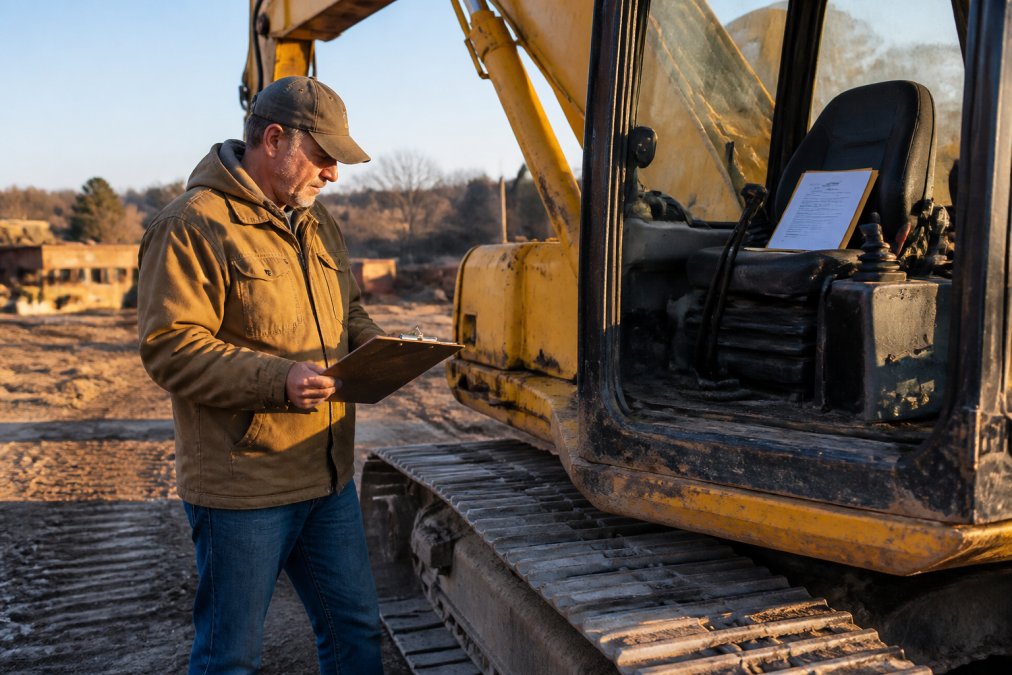
For smaller units, the lender may accept photos of the hour meter, data plate, and serial number along with your description. For larger or older machines, an independent inspector may walk the unit and produce a written report. Expect the inspector to check:
- Undercarriage, tracks, and final drives
- Hydraulic cylinders, hoses, and pump condition
- Engine hours against the hour meter reading
- Frame cracks, welds, and prior repair evidence
- Tire or track remaining life
The report becomes the lender’s basis for the offer. A clean inspection usually means a higher advance against value; a flagged one means a lower offer or a request for more down.
FIND OUT HOW MUCH YOUR BUSINESS CAN BORROW TODAY ! →
Term Structures You Will See
Used equipment deals typically run shorter than new-equipment deals because the asset has less remaining life. Common structures include:
- Term loans with fixed payments over a set number of months, matched roughly to the machine’s remaining useful life.
- Seasonal or skip-payment structures for contractors whose revenue is weather-dependent.
- Application-only approvals for smaller requests, where the machine details and business profile carry the decision.
Application-Only Approvals vs. Full Documentation
Application-only approvals rely on your business profile and the equipment details, with no bank statements submitted. Full-documentation approvals require financial statements and are typically used for larger requests or unusual equipment.
For most contractors buying a single machine, the application-only path is faster and simpler. Expect to provide the machine information and sign the agreement, nothing more.
Financing Pre Approvals with Always Capital
A pre approval tells you what you can spend before you start shopping. That matters in used equipment because good machines sell quickly, and a seller will hold a unit for a buyer who already has approval in hand.
Always Capital issues pre approvals with a soft credit pull only, so the inquiry does not affect your credit score.
Financing for Older Equipment and Trucks
Age is the obstacle that stops most used equipment deals. Many lenders cap equipment at a set number of years or miles, which rules out the well-maintained machines that offer the best value.
Financing Equipment with No Age or Mileage Restrictions
No age or mileage restrictions means the lender evaluates the machine on condition and value rather than an arbitrary cutoff. That opens up categories most buyers assume are unfinanceable.
Eligible units include:
- Excavators, mini excavators, and backhoes
- Skid steers, wheel loaders, and crawler equipment
- Dozers, graders, and compactors
- Dump trucks, daycabs, and box trucks
- Pavers, tractors, and forestry equipment
Business Financing for All Credit Types
Credit history is the second obstacle in used equipment purchases, and it is the one buyers worry about most. A past collection account or a thin credit file does not automatically end the conversation.
Verifying Private Party Sales and Title Transfer
Private party sales carry the best prices and the worst paperwork risk. Unlike a dealer, a private seller may not hold a clean title, and a lien on the machine will follow it to you. Most financing guides skip this entirely and assume a dealer is on the other side of the table. Here is how to close that gap.
Why Private Sales Are Harder to Finance
A dealer can hand the lender a title, a warranty history, and a service record in one packet. A private seller often has none of those. Lenders respond by asking for more verification before they release funds. The deal is still financeable, but the paperwork burden shifts to you.
FIND OUT HOW MUCH YOUR BUSINESS CAN BORROW TODAY ! →
The Lien Problem
A lien is a legal claim against the machine held by someone the seller owes money to. If the seller financed the unit and stopped paying, the lienholder can repossess it from you, even though you paid the seller in full. This is the single most common way private buyers lose money.
Run these checks before you hand over funds:
- Request the title and confirm the seller’s name matches
- Search your state’s lien records for the machine’s serial number
- Verify the serial number against the manufacturer or a dealer
- Confirm the seller is the registered owner, not a broker
- Get a signed bill of sale with the serial number and date
- Complete the title transfer with your state motor vehicle agency
Titled vs. Untitled Equipment
Trucks, trailers, and many larger machines carry a certificate of title issued by a state agency. The transfer is a formal process: the seller signs the title over, you submit it, and a new title is issued in your name. A lender will usually hold the title until the loan is satisfied.
Title Brands to Watch For
A title brand is a permanent notation that flags a machine’s history. Common brands include salvage, rebuilt, flood, and lemon law buyback. A branded title can make a unit hard or impossible to finance, and it will follow the machine for life. Ask the seller for a title copy before you travel to see the unit, and walk away if the brand is not disclosed up front.
What Lenders Want From a Private Sale
When you apply for financing on a private-party purchase, expect the lender to ask for:
- A copy of the title or a lien search result
- A signed purchase agreement or bill of sale
- Photos of the machine, hour meter, and data plate
- The seller’s contact information for verification
- Proof of insurance once the deal closes
Conclusion
Used equipment carries real risk: hidden liens, worn components, and paperwork gaps that surface after the money changes hands. Each one is manageable when you check the machine, verify the title, and line up funding before you negotiate.
Frequently Asked Questions
What documents are required to apply for used equipment financing?
For application-only approvals up to $500,000, Always Capital does not require financial statements or bank statements. You provide basic business information and equipment details, and the soft credit pull means your score is not affected. For requests above $500,000, additional documentation may be needed to complete underwriting. The fastest way to find out exactly what applies to your situation is to start the application and get a pre-approval decision.
How does the age of used construction equipment affect financing eligibility?
Many lenders limit financing to equipment under a certain age or mileage, which can leave older machines unfundable. Always Capital finances equipment with no age or mileage restrictions, so a 15-year-old excavator or a high-mileage dump truck can still qualify. The equipment’s condition and current market value matter more than the model year. This opens up options for contractors who buy well-maintained older machines at lower acquisition costs.
Can I finance used equipment with different credit backgrounds?
Yes. Always Capital offers business financing for all credit types and accepts all applications. Whether you have strong business credit or past issues on your report, the application process is the same, and the soft credit pull means checking your options does not hurt your score. Approval decisions focus on the overall picture, including the equipment being financed and your business revenue, not just a single credit number.
How quickly can I get approved for construction equipment financing?
Always Capital provides approvals in as little as two to four hours for many applications. The process starts with a soft credit pull, so you can see your options without any impact to your credit score. Once approved, funding can move the same day, which matters when you are trying to close on a used excavator, dozer, or dump truck before another buyer does. Have your equipment details ready to speed things up.