
Last Updated: November 4, 2026
Quick Summary
Personal credit reports track an individual’s borrowing history, such as credit cards, mortgages, auto loans and payment behavior, and are maintained by the three consumer bureaus. Business credit reports track a company’s payment history with vendors, suppliers and lenders, plus public records tied to the business entity, and are compiled by commercial bureaus.
- Personal reports are maintained by the three consumer bureaus; business reports are compiled by commercial bureaus.
- Business trade reporting is often quarterly or on-demand, so a business file can look thin even when bills are paid on time.
- Vendors that report to commercial bureaus are needed for on-time payments to reach a business file.
- Many lenders require a personal guarantee, which ties business obligations back to your personal credit profile.
- Forming an LLC or corporation with its own EIN and bank account creates the separation needed to build business credit.
Table of Contents
- What Each Type of Credit Report Covers
- Who Can See Your Personal and Business Credit Reports
- How Personal and Business Scores Are Calculated
- When Personal Credit Shows Up on Business Credit and Why Personal Guarantees Matter
- How to Build Business Credit Separately From Your Personal Profile
- The Impact of Personal Credit on Business Financing
- Next Steps for Your Equipment Financing Application With Always Capital
- Frequently Asked Questions
What Each Type of Credit Report Covers
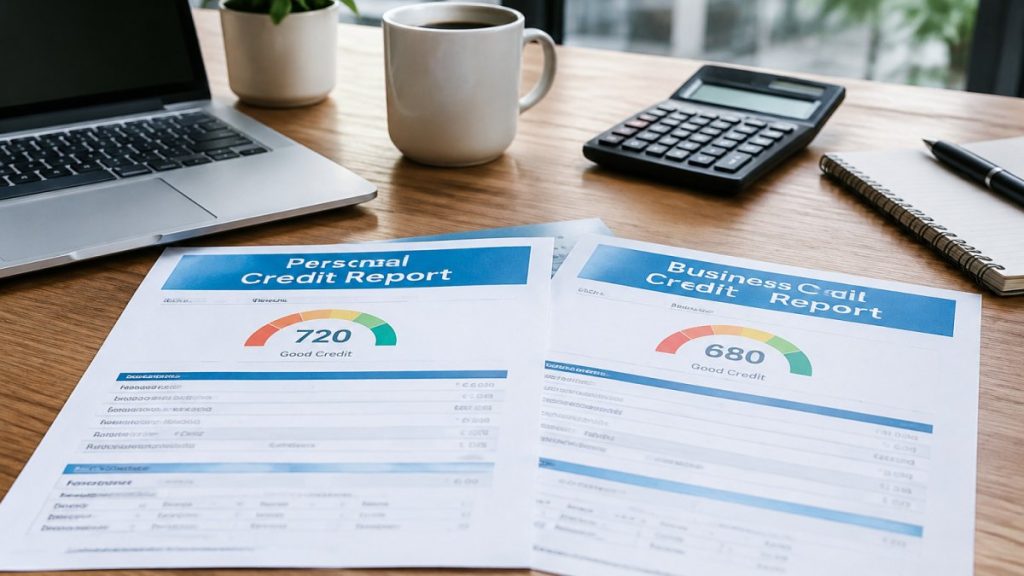
A personal credit report tracks an individual’s borrowing history, including credit cards, mortgages, auto loans and payment behavior. A business credit report tracks a company’s payment history with vendors, suppliers and lenders, along with public records tied to the business entity. The two reports draw from different data and are kept by different agencies, so a strong personal file does not automatically produce a strong business file.
Many owners assume one report covers both. It does not. Personal reports are maintained by the three consumer bureaus, while business reports are compiled by commercial bureaus that focus on trade references, filings and payment timing.
Recent survey data shows how often the two overlap in practice. According to the Federal Reserve Small Business Credit Survey, 2026 Report on Employer Firms, 59% of employer firms with debt used a personal guarantee to secure financing, and 51% used business assets as collateral. That overlap is why the distinction matters when you apply for financing.
The two report types differ in what they track, who maintains them, and where their data comes from.
| Report | Tracks | Maintained by |
|---|---|---|
| Personal credit report | Individual borrowing history, payment behavior | Three consumer bureaus |
| Business credit report | Vendor and supplier payments, public records tied to the entity | Commercial bureaus |
| Data overlap | Strong personal file does not automatically mean strong business file | Different agencies |
Who Can See Your Personal and Business Credit Reports
Access to each report is governed by different rules. Personal credit reports generally require the consumer’s permission before a lender pulls a full report, though a soft inquiry may be used for pre-qualification. Business credit reports are often available to other companies evaluating a vendor, supplier or potential partner, and that access does not always require the business owner’s consent.
Watch out: Assuming your personal file is private from a vendor is a mistake. If you personally guarantee a business obligation, the lender can review your personal credit as part of underwriting.

Always Capital uses soft credit pulls for initial pre-qualification, so checking your options does not affect your personal or business score. Learn more about equipment and truck financing with soft pulls before you apply.
How Personal and Business Scores Are Calculated
Personal credit scores weigh payment history heavily, followed by credit use, length of credit history, the mix of accounts and recent inquiries. The underlying data flows from the three consumer bureaus, which receive monthly updates from card issuers, mortgage servicers and auto lenders. That monthly cadence is why a personal file reacts quickly to a missed payment or a paid-down balance.
Check Your Eligibility with No Credit Risk – Click to Get Approved Today! →
Business credit is scored on entirely different models, and the differences matter more than most owners realize.
- Scale and model. Commercial bureaus build their own scores. The Dun & Bradstreet PAYDEX score runs from 1 to 100 and is built primarily around trade payment behavior, according to Bluevine’s guide to business versus personal credit. Other commercial models blend trade lines, public filings and firmographics.
- Data sources. Business files are fed by vendor and supplier trade references, commercial lenders, public records such as liens and judgments, and business registration data. Consumer files are fed by consumer lenders and card issuers. The two data pools barely overlap.
- Reporting frequency. This is the gap most guides skip. Personal reporting runs on a predictable monthly cycle. Business trade reporting is often less frequent or on-demand, a supplier may report quarterly, only when an account crosses a threshold, or not at all. A business file can therefore look thin or stale even when the company pays every bill on time.
- Industry risk classification. Business reports carry industry-specific risk metrics that personal reports have no equivalent for. Commercial models factor in the risk profile of the company’s sector, its size band and its years in operation. Two businesses with identical payment histories can score differently because one operates in a higher-risk industry classification.
Because the models, data sources and cadences differ, a company can carry a strong PAYDEX score while its owner’s personal score is average, or the reverse. A common pattern is an owner with an excellent personal file and a nearly blank business file, simply because no vendor ever reported the company’s payments.
Watch out: Assuming a clean payment record automatically produces a strong business score is a mistake, if your vendors do not report to commercial bureaus, those on-time payments never reach the file.
When you apply for equipment or truck financing, Always Capital reviews both profiles together and uses soft credit pulls for initial pre-qualification, so checking your options does not affect either score. Learn more about equipment and truck financing with soft pulls and how business credit use and borrowing power shape approvals before you apply.
When Personal Credit Shows Up on Business Credit and Why Personal Guarantees Matter
Personal credit enters the business picture most often through personal guarantees. When an owner signs one, the owner becomes personally liable for the debt if the business cannot pay. That liability can show up on the owner’s personal file and affect future personal borrowing.
The Federal Reserve Small Business Credit Survey findings reinforce how common this is. A majority of small firms with debt rely on guarantees, which ties business obligations directly to personal credit profiles.
Lenders vary in how they structure guarantees, so review the terms before signing.
How to Build Business Credit Separately From Your Personal Profile
Separating the two profiles protects personal assets and can lead to higher financing limits over time. Most guides stop at “get an EIN and pay on time.” The mechanics that actually create separation are more specific.
Structure the entity first. A sole proprietorship offers no legal wall between owner and company, business debts and reporting can land on the owner’s personal file. Forming a limited liability company or corporation, registering it with its own Employer Identification Number (EIN), and opening a business bank account under that EIN creates the legal and financial separation the rest of the process depends on. This is the core of the credit shield concept: the entity, not the individual, becomes the borrowing and reporting subject.
Build trade lines that actually report. Open accounts with vendors and suppliers that report payment history to commercial bureaus, and confirm reporting before you rely on a vendor. Because business reporting is often quarterly or on-demand rather than monthly, a handful of reporting trade lines beats dozens of non-reporting ones.
Keep the files clean. Pay every account on time, keep balances low relative to limits, and check your business reports regularly for errors. Dispute resolution works differently on each side: personal report errors are disputed directly with the consumer bureau and the furnisher under the Fair Credit Reporting Act, while business report errors are disputed with the commercial bureau that holds the file, which runs its own investigation process and timeline. Keep records of every dispute and follow up in writing.
Watch out: Commingling personal and business funds can weaken the legal separation between owner and company, pierce the credit shield, and make it harder to build a clean business file, keep every business transaction in the business account.
Check Your Eligibility with No Credit Risk – Click to Get Approved Today! →
Plan for the personal guarantee. Even with a clean structure, many lenders require a personal guarantee, which ties the obligation back to your personal profile. Ask upfront whether a guarantee is required and how it will be reported.
Our guide on building business credit and improving your business credit score for loans covers these steps in more detail. When you are ready to finance equipment or a truck, Always Capital works with all credit types, offers up to 100% financing, and provides approvals in as little as two to four hours, visit Always Capital’s equipment and truck financing page to request a pre-approval.
The Impact of Personal Credit on Business Financing
For many small companies, especially those without a long credit history, lenders weigh the owner’s personal profile heavily. A strong personal score can offset a thin business file, while a weak one can narrow options even when the business is performing well.
Equipment financing works differently because the machinery itself secures the loan. That structure is one reason Always Capital can work with all credit types. Always Capital offers up to 100% financing, approvals in as little as two to four hours and funding for heavy equipment and commercial trucks. Read more about what credit score and down payment you need for heavy equipment financing.
Understanding your personal and business profiles before you apply lets you prepare the right documentation and choose a structure that fits your situation.
Next Steps for Your Equipment Financing Application With Always Capital
Start by pulling your personal and business reports and noting any errors or unfamiliar accounts. Decide whether a personal guarantee is acceptable for your situation. Then compare structures that fit your cash flow, including deferred payment options of 30, 60 or 90 days.
To see what Always Capital can offer for your equipment or truck purchase, visit Always Capital’s equipment and truck financing page and request a pre-approval.
Frequently Asked Questions
Does my personal credit score affect my business loan eligibility?
Often, yes. Many lenders review the owner’s personal credit, especially for newer or smaller businesses, because the business may not yet have a long credit history of its own. Lenders often rely on personal guarantees for small-business financing, which means the owner’s personal credit can be part of the decision. Established businesses with strong business credit may be evaluated more on their own record. Always Capital reviews applications for all credit types and uses soft credit pulls, so checking your options does not hurt your credit.
Who can access my business credit report?
Business credit reports can generally be pulled by other businesses, such as vendors, lenders and potential partners, often without the owner’s consent. Personal credit reports typically require consumer consent before a lender can access them. This difference is one reason owners separate the two profiles. Keeping your business entity, identification number and accounts distinct from your personal ones helps ensure that commercial reports reflect the business alone.
How can I build a strong business credit profile?
Start by registering your business with its own Employer Identification Number, opening business bank accounts and setting up accounts with vendors that report to business credit bureaus. Pay every obligation on time, keep balances low and check your business report regularly for errors. Consistent payment history over time is what builds a profile lenders can rely on.
Do business credit reports include personal financial history?
Generally, no. A business credit report focuses on the company’s payment history, public records, registration information and trade accounts. Personal items such as your individual credit cards or personal loans normally appear only on your personal report. The exception is a personal guarantee, which ties the owner’s personal liability to the business debt.
