
Last Updated: November 24, 2026
Quick Summary
Commercial truck financing from private party sellers uses the truck as collateral, so the lender verifies the title and the buyer’s business instead of relying on a dealer. Always Capital funds private-party purchases directly with soft pulls only and approvals in one to three hours.
- The seller must provide an original title in their name, a bill of sale, and any lien release.
- A title name that does not match the seller’s ID is the most common reason a private sale collapses.
- Never pay the seller in full and trust them to pay off their own loan.
- Always Capital approves in one to three hours with soft pulls only, up to $500,000 application-only.
- Never hand the seller cash or a wire before the lender confirms the title is clean.
Table of Contents
- How Does Financing Commercial Trucks From Private Party Sellers Work?
- Which Commercial Trucks Can Be Financed From a Private Seller?
- Top 5 Truck Manufacturers Buyers Finance From Private Sellers
- Private Seller Truck Financing: What Lenders Need From Both Sides
- Financing a Truck From a Private Seller
- Types of Private-Party Trucks Always Capital Finances
- Top Truck Manufacturers Buyers Finance
- Used Commercial Truck Financing and Commercial Vehicle Financing for Startups
- Get Pre-Approved Before You Make an Offer
- Types of Private-Party Commercial Trucks Always Capital Finances
- Top 5 Truck Manufacturers Always Capital Finances
- Frequently Asked Questions
How Does Financing Commercial Trucks From Private Party Sellers Work?
Financing commercial trucks from private party sellers works by using the truck itself as collateral, so the lender evaluates the vehicle and the buyer’s business rather than requiring a dealer relationship. Always Capital funds private-party purchases directly, with soft credit pulls only and approvals in one to three hours.
The process differs from a dealership deal in one key way: there is no dealer to handle paperwork or vouch for the asset. The lender must confirm the seller actually owns the truck, that the title is clean, and that the price matches the truck’s real value.
That extra verification is the whole ballgame.
Which Commercial Trucks Can Be Financed From a Private Seller?
Private-party financing is not limited to one type of truck. Always Capital finances most classes of commercial trucks bought directly from an individual owner, including:
- Dump trucks
- Flatbeds
- Box trucks
- Tankers
- Reefers
- Dry van trucks
- Day cabs and sleeper trucks
The lender looks at the same things regardless of body type: a clean title, a fair price for the truck’s age and mileage, and a buyer whose business can support the payment.
Top 5 Truck Manufacturers Buyers Finance From Private Sellers
Most private-party truck sales involve a handful of well known manufacturers. The five that come up most often are:
- Freightliner
- Peterbilt
- Kenworth
- International
- Volvo
Lenders are familiar with these brands’ resale values, which can make the appraisal step faster than it is for a less common make.
Why Lenders Treat Private Sales Differently
Most lenders prefer dealer transactions because the dealer supplies title work, inspection records, and a known paper trail. Private sales hand the lender none of that.
So underwriting shifts to the asset and the buyer. Lenders typically ask three questions:
- Does the seller hold a clean, transferable title?
- Is the truck worth the agreed purchase price?
- Can the buyer’s business support the repayment term?
A common mistake is assuming a private sale is automatically harder to finance. For a closer look at what underwriters weigh first, see this breakdown of what lenders check first on a commercial truck loan approval.
Private Seller Truck Financing: What Lenders Need From Both Sides
Private seller truck financing requires documentation from two parties, not one. The seller proves ownership and the buyer proves the business can carry the loan. Missing paperwork from either side stalls closing, and a missing lien release is the most common reason a private sale collapses at the last minute.
High mileage is rarely a dealbreaker here. Always Capital finances equipment and trucks with no age or mileage restrictions, which matters because private-party trucks are often older and well-used. If that describes your situation, financing for high mileage commercial trucks explains how approval works when the odometer is high.
Types of Private-Party Commercial Trucks Always Capital Finances
Private seller truck financing is not limited to one body style. Always Capital finances a wide range of commercial trucks bought from private sellers, including:
- Dump trucks
- Flatbeds
- Box trucks
- Tankers
- Reefers
Whatever the body type, the underwriting questions stay the same: clean title, fair purchase price, and a buyer whose business can support the loan.
Top 5 Commercial Truck Manufacturers
Private sellers most often list trucks from a handful of established manufacturers. The five names buyers see most are:
- Freightliner
- Peterbilt
- Kenworth
- International
- Volvo Trucks
Financing works the same way regardless of make or model: the lender is underwriting the title, the price, and the buyer’s business, not the badge on the hood.
Documents the Seller Must Provide
The seller’s job is to prove clean ownership. Ask for these before any money moves:
- Original certificate of title in the seller’s name
- Government-issued photo ID matching the title
- Bill of sale with the vehicle identification number, price, and date
- Lien release or payoff statement if a prior loan was paid off or is still open
Watch out: a title with a name that does not match the seller’s ID is the single most common reason a private sale falls apart at closing. A seller who is “selling for a friend” or whose name is not on the title cannot legally transfer it without a power of attorney.
When the Seller Still Owes on the Truck
Many private-party trucks are not paid off. That does not kill the deal, but it changes the closing sequence. The seller’s existing lienholder holds the title, so the buyer’s lender and the seller’s lender must coordinate.
A common pattern works like this: the seller requests a written payoff quote from their lienholder, and the payoff is coordinated at closing so the lienholder releases the title.
Documents the Buyer Must Provide
Buyers need far less than they expect. Always Capital offers application-only approvals up to $500,000.
Typical buyer items include:
- Completed credit application
- Business identification and entity documents
- Proof of insurance on the truck
- Purchase agreement or signed bill of sale
For a full walkthrough of the factors underwriters review, how to qualify for commercial truck loans covers the five requirements and which documents speed up approval. If your credit history is challenged, bad credit equipment loans explains how asset-backed underwriting weighs the truck alongside your revenue.
Financing a Truck From a Private Seller
Financing a truck from a private seller follows a sequence: verify the truck, agree on price, get pre-approved, confirm the title, then close and fund.
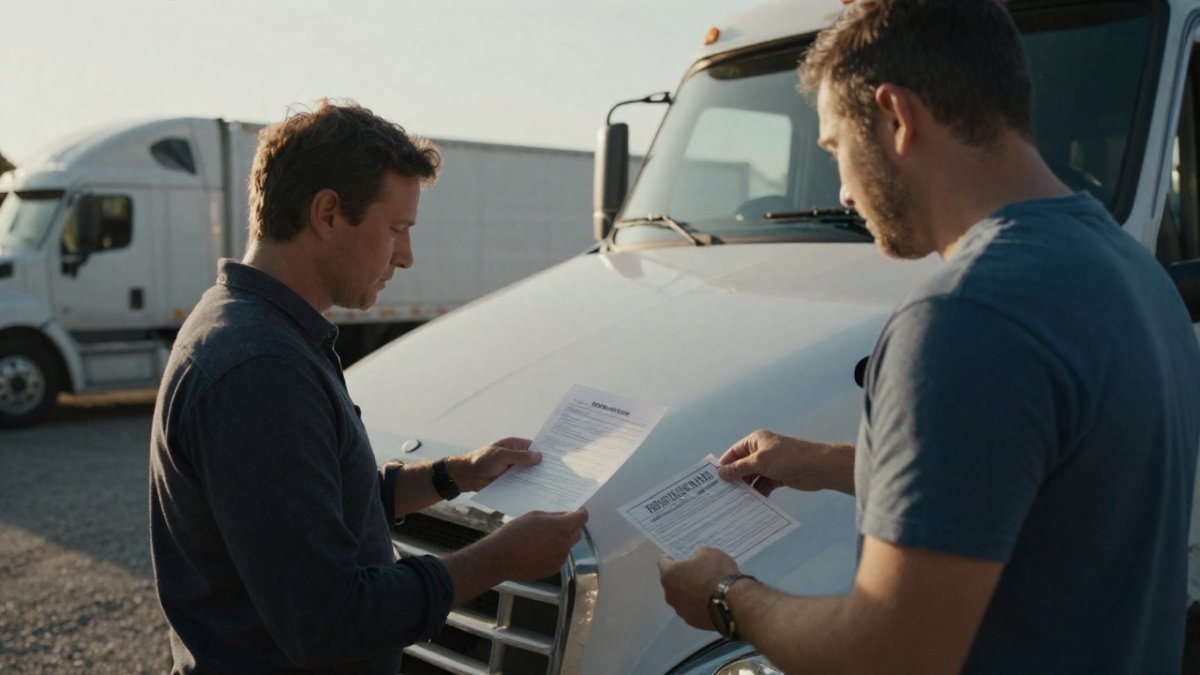
Here is the order that works, with the mechanics behind each step:
- Inspect the truck and pull a vehicle history report. Run the VIN through a vehicle history report to check for salvage branding, odometer rollback, and prior liens. Have a diesel mechanic inspect the engine, transmission, aftertreatment system, and frame. A pre-purchase inspection is the cheapest insurance in a private sale.
- Confirm the seller’s title is clean and in their name. The name on the title must match the seller’s government-issued photo ID. If a lienholder is listed on the title, the truck is not free and clear, see the lien section below before you go further.
- Agree on a written price and sign a bill of sale. The bill of sale should list the VIN, year, make, model, odometer reading, purchase price, date, and both parties’ signatures. Always Capital offers all-inclusive cost packages that can roll soft costs, registration, and delivery into the total loan value, so confirm what is included before you sign.
- Apply for pre-approval before promising payment. Always Capital approves in one to three hours with soft pulls only, so you can walk into the negotiation knowing your number. Application-only approvals up to $500,000 do not require financial statements.
- Send title and documents to the lender for review. The lender verifies the title, confirms the VIN against the truck, and evaluates the truck’s utility.
- Close the loan and record the lien. The lender funds the purchase and records its lien on the title. The title is then updated to show the lender as lienholder.
- Transfer the title at the DMV and register the truck. Bring the signed title, bill of sale, lien release or lienholder information, proof of insurance, and your business documents to the DMV.
Watch out: never hand the seller cash or a wire before the lender has confirmed the title is clean and the lien will be recorded.
The full process, including how liens and title transfers are handled, is covered in this guide to getting used commercial truck financing.
Types of Private-Party Trucks Always Capital Finances
Private-party sales are not limited to one truck type. Always Capital finances a wide range of commercial trucks bought directly from an owner, including:
- Dump trucks
- Flatbeds
- Box trucks
- Tankers
- Reefers
- Dry vans
- Day cabs and sleeper tractors
The same closing sequence applies regardless of truck type: verify the title, confirm the lien status, and get pre-approved before funds change hands.
Top Truck Manufacturers Buyers Finance
Most private-party commercial truck sales involve one of a handful of well established manufacturers. The most common include:
- Freightliner
- Peterbilt
- Kenworth
- Volvo Trucks
- Mack Trucks
Lenders evaluate these makes the same way they evaluate any other truck: by checking the VIN, title, and mechanical condition rather than the brand name alone.
Used Commercial Truck Financing and Commercial Vehicle Financing for Startups
Used commercial truck financing and commercial vehicle financing for startups both hinge on the asset, not on a long credit history. New businesses under two years old can access up to $150,000 through Always Capital, and all credit types are accepted.
Startups face one extra hurdle: lenders want proof the truck will earn. A signed hauling contract or a booked job helps.
Always Capital offers:
- Up to 100% financing with $0 down
- Terms from 24 to 84 months
- 30-, 60-, or 90-day payment deferrals
- Soft pulls only, so applying does not hurt your credit
Situation | Best Fit | Why |
|---|---|---|
Startup under 2 years | Application-only approval | No financials up to $500,000 |
Challenged credit | All-credit program | Asset-backed underwriting |
Older high-mileage truck | No age or mileage limits | Value based on utility |
Tight cash flow | Deferred payments | First payment pushed out |
Get Pre-Approved Before You Make an Offer
Pre-approval before you make an offer is the step that separates a smooth private purchase from a stressful one.
Always Capital approves in one to three hours with soft pulls only. That means you can walk into a private sale knowing your number.
Apply for fast commercial truck financing with 2-hour approvals and start the process before you shake hands on a price.
Types of Private-Party Commercial Trucks Always Capital Finances
Always Capital finances a wide range of commercial trucks bought from private sellers, not just one body style. The asset-backed approach works whether the truck hauls dirt, dry freight, or liquid cargo.
- Dump trucks
- Flatbeds
- Box trucks
- Tankers
- Reefers
- Dry vans
- Day cabs and sleeper tractors
Top 5 Truck Manufacturers Always Capital Finances
Private-party deals span every major manufacturer. Always Capital‘s asset-backed underwriting applies the same way regardless of brand.
- Freightliner
- Peterbilt
- Kenworth
- International
- Volvo Trucks
A private-party truck deal rewards preparation. The buyers who close cleanly are the ones who line up funding first, verify the title early, and keep the seller’s paperwork organized. Always Capital was built for exactly this kind of purchase: 100% financing options, approvals in one to three hours, soft pulls only, no age or mileage restrictions, and terms from 24 to 84 months with deferral options. Get pre-approved with Always Capital and buy your next truck with confidence.
Frequently Asked Questions
Can I finance a truck from a private seller?
Yes. Many commercial truck lenders, including Always Capital, finance private-party purchases the same way they finance dealer sales. The main difference is paperwork: you need a clean title in the seller’s name, a signed bill of sale, and a lien payoff letter if the seller still owes on the truck. Get pre-approved first so you can make a firm offer.
What information does a lender need for a private-party truck purchase?
Expect to provide your business name and address, time in business, and an application with a soft credit pull. For the truck itself, the lender needs the VIN, year, make, model, mileage, and asking price, plus photos and the seller’s contact details. The seller supplies the title, a government ID, and a bill of sale. Always Capital offers application-only approvals up to $500,000.
Can a startup get commercial vehicle financing for a private-party truck?
Yes. Businesses under two years old can qualify, and Always Capital offers startup-friendly limits up to $150,000. Underwriting weighs the truck’s working value and your revenue alongside credit history, so a thin file is not an automatic decline. A soft credit pull lets you check eligibility before you commit.
How do I confirm ownership before buying a truck from a private seller?
Ask for the original title and match the VIN on the title to the VIN plate on the truck and the bill of sale. Check that the seller’s name and ID match the title exactly. If a lien is listed, request a payoff letter from the lienholder and confirm the lender will handle the payoff at closing. Run a VIN history report and inspect the truck in person before any money moves. Always Capital can walk you through title and lien steps.
