

Table of Contents
- What Flexible Loan Terms Mean for Your Equipment Purchase
- Understanding Equipment Loan Term Lengths: 24 to 84 Months
- How Heavy Equipment Financing for Bad Credit Works
- Financing Older Heavy Machinery: Age and Mileage Rules
- Fast Business Equipment Funding: From Application to Approval
- Why Equipment Depreciation Should Guide Your Term Choice
- Your Step-by-Step Plan to Get Approved with Challenged Credit
- Conclusion: Start Your Equipment Financing Application Today
- Frequently Asked Questions
Last Updated: September 9, 2026
What Flexible Loan Terms Mean for Your Equipment Purchase
Equipment financing terms are the conditions that define how you repay a loan for machinery, vehicles, or other hard assets, including the repayment period and payment schedule, and understanding these equipment financing terms is essential before you sign. For businesses with challenged credit, securing flexible loan terms from 24 to 84 months can be the difference between upgrading your fleet and falling behind. At Always Capital, we specialize in connecting businesses with lenders who evaluate more than just a credit score, which is why we see approvals for all credit types.
A longer term, such as 84 months, lowers the monthly payment, which directly improves cash flow for payroll, fuel, and maintenance. However, a longer term also means the loan may outlast the equipment’s most productive years.
Understanding Equipment Loan Term Lengths: 24 to 84 Months
Shorter terms of 24 to 36 months build equity faster and reduce the time you carry debt, but they require higher monthly payments that can strain working capital. Longer terms from 60 to 84 months lower the monthly obligation, making it easier to manage cash flow, but they extend the period during which your equipment depreciates faster than you pay down the principal.
| Term Length | Typical Monthly Payment | Best For | Key Consideration |
|---|---|---|---|
| 24-36 months | Higher | Businesses with strong cash reserves | Fastest equity building |
| 48-60 months | Moderate | Standard replacement cycles | Balanced payment and term |
| 72-84 months | Lower | Cash flow preservation | Match to equipment life |
The right choice depends on your projected revenue and the expected life cycle of the asset.
How Heavy Equipment Financing for Bad Credit Works
Heavy equipment financing for bad credit works by using the equipment itself as collateral, which reduces the lender’s exposure and allows underwriters to weigh your business’s revenue potential alongside your personal credit history. Lenders may review your business credit score, time in operation, and the equipment’s expected resale value rather than relying on a single credit number.
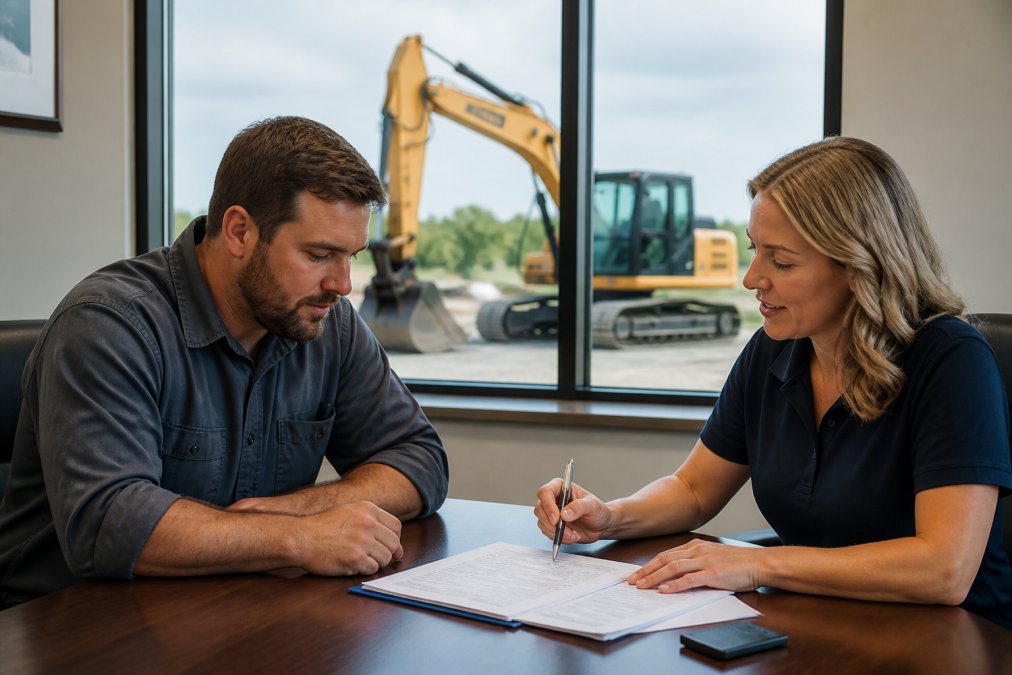
Many lenders in this space perform a soft credit pull during the initial application, which does not impact your credit score. Underwriting focuses on your ability to repay and the loan-to-value ratio of the equipment. Because the asset backs the loan, lenders are more willing to work with borrowers who have experienced bankruptcy, repossession, or slow payments.
Financing Older Heavy Machinery: Age and Mileage Rules
Financing older heavy machinery often fails because many lenders impose strict age and mileage caps that exclude equipment past a certain point. Lenders set these restrictions to protect against depreciation risk.
Some financing providers, including Always Capital, offer financing for older equipment and trucks with no restrictions on age or mileage. When seeking financing for older machinery, expect the lender to order an appraisal or use the purchase price to establish the loan amount. The term length should align with the remaining useful life of the machine; financing a 15-year-old bulldozer over 84 months is rarely wise, whereas a 36-month term may be a perfect match.
How Lenders Value Older Equipment
When a lender evaluates a 12-year-old dump truck with 400,000 miles, they are looking at the wholesale auction value, often determined by resources like the Truck Blue Book or Machinery Trader listings. For a credit-challenged borrower, the gap between the seller’s asking price and the lender’s appraised value can be a reason for a denial or a request for a larger down payment.
Before you apply, pull comparable listings for the exact make, model, year, and hour or mileage range. A lender will only finance up to the lower figure.
The Condition Report Is Your Best Tool
For older equipment, a third-party condition inspection can be beneficial. Lenders may be less concerned about the odometer reading when a certified mechanic’s report shows that the engine compression is strong, the hydraulics are dry, and the undercarriage has a significant portion of its life remaining.
When you submit your application, attach the inspection report, recent maintenance logs, and a list of new parts installed in the last 12 months. This documentation can help shift the lender’s focus from the equipment’s age to its operational readiness.
Alternative Collateral: Strengthening Your Position
If the older equipment itself does not provide enough collateral value, lenders who work with all credit types may accept a blanket lien on other business assets. This means you pledge additional machinery, a fleet vehicle you own outright, or even a piece of real estate as a secondary position.
A common pattern is to pledge a fully paid-off piece of equipment as extra security. For example, if you own a 2018 skid steer outright and you are financing a used excavator, the lender may take a lien on both units. Be prepared to provide titles or registration documents for any asset you offer as collateral. The more you can show the lender that the loan is secured by real, sellable assets, the less weight your personal credit history may carry in the final decision.
Do not offer collateral that is essential for daily operations if you cannot afford to lose it. If you default, the lender has the right to seize any asset pledged against the loan. Only offer equipment or property that you could part with without shutting down your core revenue-generating work.
Fast Business Equipment Funding: From Application to Approval
Fast business equipment funding is achievable when you work with a lender that uses application-only underwriting for smaller loan amounts. Always Capital offers same day approvals within 2-4 hours, which means you can submit an application in the morning and have a decision before the workday ends.
The application process typically requires basic business information, details about the equipment you intend to purchase, and a soft credit pull. For application-only approvals up to $500,000, no financials are required. Once approved, funding can occur quickly, allowing you to secure the equipment and start generating revenue without a lengthy waiting period. Deferred payment plans of 30, 60, or 90 days are often available.
Why Equipment Depreciation Should Guide Your Term Choice
Equipment depreciation is the rate at which an asset loses value over time, and it should guide your term choice because you do not want to owe more than the machine is worth if you need to sell it or upgrade.
A practical approach is to match your loan term to the equipment’s useful life. For example, a new skid steer might have a productive life of 7 to 10 years, making an 84-month term reasonable. A used truck with high mileage may only have 3 to 4 years of reliable service left, so a 36 to 48-month term is safer.
Depreciation Curves by Equipment Type
Not all equipment depreciates at the same pace. Here are general patterns for major categories:
| Equipment Category | Typical Useful Life | Depreciation Pattern | Recommended Max Term |
|---|---|---|---|
| New Excavators (20+ ton) | 10-12 years | Steepest in first 3 years, then stabilizes | 84 months |
| Used Dump Trucks (high mileage) | 3-5 years remaining | Rapid, driven by engine and transmission wear | 36-48 months |
| Skid Steers / Compact Track Loaders | 7-10 years | Moderate, strong resale market | 72-84 months |
| Trailers (dry van, flatbed) | 15+ years | Slow, minimal depreciation after initial years | 84 months |
| Specialized Attachments (grapples, thumbs) | 5-7 years | Moderate, but limited resale market | 48-60 months |
These are general patterns, not guarantees.
The “Underwater” Trap and How to Avoid It
The danger of an 84-month term on the wrong asset is that you owe more than the equipment is worth for a significant portion of the loan. If you need to sell the machine at month 40, you may have to cover the difference between the loan payoff and the sale price.
To avoid this trap, consider that the loan term should not exceed the period during which you expect the equipment to generate positive cash flow without major capital repairs. If you are unsure, choosing the shorter term can be a prudent approach.
The Refinance and Upgrade Pathway
A longer term is not a life sentence. Businesses may use an 84-month term to keep initial payments low, then refinance or trade in the equipment at month 36 or 48 once they have built equity and improved their business credit profile.
To execute this strategy successfully, tracking your equipment’s resale value against your loan balance can be helpful. At the 36-month mark on an 84-month loan, checking auction prices for comparable units can indicate if you have built enough equity to trade in the unit or refinance into a shorter term. Starting with a long term to get approved, then actively managing the loan to shorten it as your business improves, can be a viable approach.
The right term is not the lowest payment. It is the longest term you can take without risking a negative equity position when the equipment’s productive life ends. For new, long-lived assets, 84 months is often safe. For used, high-hour units, 36-48 months is the disciplined choice.
Your Step-by-Step Plan to Get Approved with Challenged Credit
Getting approved with challenged credit requires focusing on what you can control: your business’s current performance and the collateral you can offer. Lenders who work with all credit types are looking for signs that your business generates enough cash flow to cover the new payment.
- Review your business credit profile. Obtain your business credit scores from the major bureaus and check for errors that could be dragging your score down.
- Prepare your equipment details. Know the make, model, year, and mileage or hours on the unit you want to finance. Have the purchase price or invoice ready.
- Gather your business basics. While application-only approvals up to $500,000 require no financials, having two to three months of bank statements ready can strengthen your file if you are seeking a larger amount.
- Choose your down payment strategy. While 100% financing is available, a larger down payment reduces the loan-to-value ratio and can increase approval odds for borrowers with significant past credit issues.
- Apply with a lender that offers flexible terms. Focus on providers that advertise support for all credit types and offer terms from 24 to 84 months.
If your credit history is particularly rough, consider offering a larger down payment or a personal guarantee to secure a better loan structure. This can show the lender you are invested in the equipment’s success and may reduce their perceived risk.
Conclusion: Start Your Equipment Financing Application Today
Securing flexible loan terms from 24 to 84 months for businesses with challenged credit is not about finding a lender willing to take a chance on you. It is about finding a partner who understands that a credit score is not the full measure of your business. Always Capital offers 100% financing options up to $5 million and can structure terms that fit your budget. Apply now to get approved and put your business on the path to growth with the equipment you need.
Frequently Asked Questions
What are the typical equipment loan term lengths I can choose from?
Most lenders offer equipment loan term lengths between 24 and 84 months. A 24-month term means higher monthly payments but you own the equipment sooner. An 84-month term spreads the cost out, lowering your monthly payment and preserving cash flow for operations. The right equipment financing terms depend on the machine’s expected lifespan and your revenue projections. Matching the loan term to how long you plan to use the equipment is a smart strategy for any business.
How can I get heavy equipment financing for bad credit?
Getting heavy equipment financing for bad credit is possible when you work with a lender that evaluates your business beyond a credit score. Expect to provide bank statements or proof of revenue. Lenders may ask for a down payment or offer flexible equipment financing terms from 24 to 84 months to manage risk. Application-only approvals up to $500,000 are available, which means no financial statements are required in some cases. The key is finding a partner that accepts all credit types.
What is the difference between a 24-month and an 84-month financing term?
A 24-month equipment financing term is shorter, so you pay off the loan faster. This usually means higher monthly payments but less total cost over the life of the agreement. An 84-month term is a longer-term option that lowers your monthly payment, which can be critical for cash flow. The trade-off is that you carry the debt longer. Choosing between these equipment loan term lengths depends on your budget and how quickly the equipment will generate revenue.
Can I finance older heavy machinery or trucks with high mileage?
Yes. Some lenders impose strict age and mileage caps, but others like Always Capital finance older heavy machinery with no restrictions on age or mileage. This is particularly useful when buying used excavators, bulldozers, or dump trucks that still have years of productive life left. When financing older units, lenders may review the equipment’s condition and market value more closely. Flexible terms from 24 to 84 months can still apply, helping you manage payments on pre-owned assets.